
Following up on President von der Leyen’s State of the Union speech in September last year, Commissioner for Crisis Management Janez Lenarčič announced today the doubling of the rescEU aerial firefighting fleet for this year’s wildfire season while speaking at the 10th anniversary of the EU’s Emergency Response Coordination Centre.
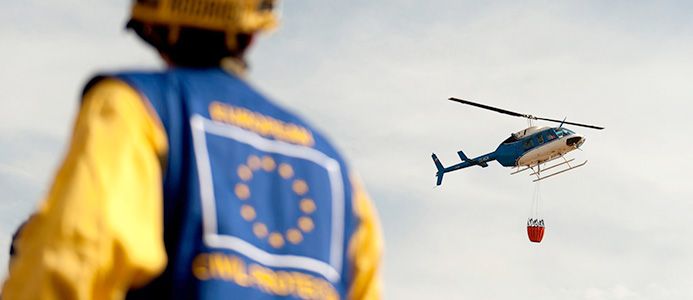
rescEU firefighting fleet for 2023
- The rescEU firefighting aircraft reserve includes 24 airplanes and 4 helicopters from 10 Member States:
- Two medium scooping airplanes from Croatia
- Two light planes from Cyprus
- Two helicopters from Czechia
- Two medium scooping airplanes and one helicopter from France
- Two light planes from Germany
- Two medium scooping airplanes, two light planes and one helicopter from Greece
- Two medium scooping airplanes and two light planes from Italy
- Two light planes from Portugal
- Two medium scooping airplanes from Spain
- Four light planes from Sweden
- In addition, Austria, Bulgaria, Finland, France, Germany, Latvia, Malta, Poland, Romania, Slovakia and Slovenia will be sending almost 450 firefighters to be prepositioned in France, Greece and Portugal.
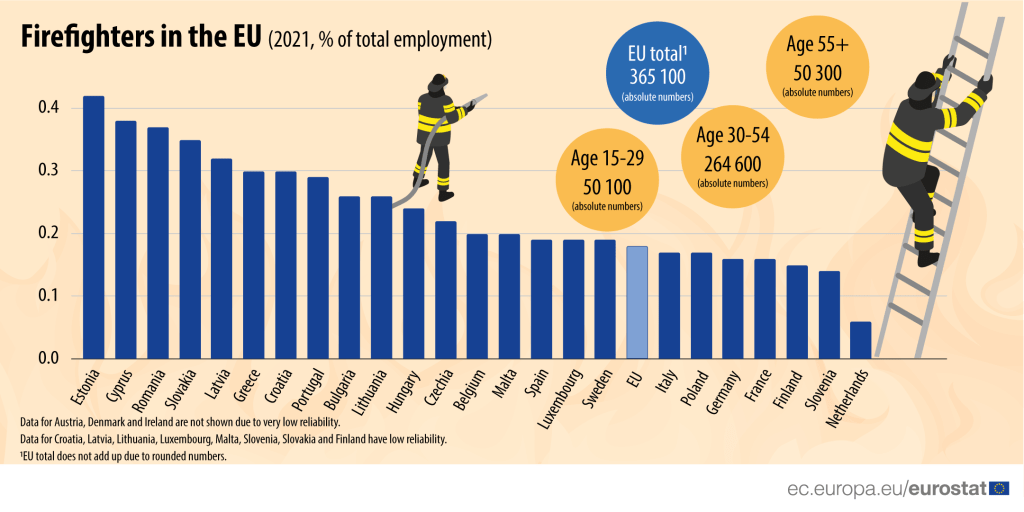
Los incendios en la UE ponen a prueba a los bomberos europeos |
Preventive and monitoring measures
Following the calls from EU Ministers and the European Parliament, in 2022 the Commission developed also a Wildfire Prevention Action Plan. This action plan is organised around three objectives: 1) improve administrative capacity; 2) improve knowledge; 3) increase investments in wildfire prevention action.
As part of the prevention action plan, the EU is launching today a new Wildfire Peer Review Assessment Methodology. This new tool helps countries assess their capacity to prevent and prepare for wildfires, and supports the exchange of good practices among European countries, within the framework of the EU Civil Protection Mechanism.
In addition, an Emergency Response Coordination Centre Wildfires Support Team is being created to enable near-real-time monitoring and analysis of the wildfire situation from mid-June to mid-September.
Background
Wildfire prevention, preparedness and response actions work hand in hand to save lives, livelihoods and protect the environment. Having experienced wildfire experts, well-trained firefighters, information technology and sufficient response assets available makes a difference.
The EU ensures a coordinated approach to preventing, preparing and responding to wildfires when those overwhelm national response capacities. When the scale of a wildfire overwhelms the response capabilities of a country, it can request assistance via the EU Civil Protection Mechanism. Once activated, the EU’s Emergency Response Coordination Centre coordinates and finances assistance made available by EU Member States and nine additional Participating States through spontaneous offers. In addition, the EU has created the European Civil Protection Pool to have a critical number of readily available civil protection capacities allowing for a stronger and coherent collective response. Should the emergency require additional, life-saving assistance, the rescEU firefighting reserve steps in to provide additional capacities to confront disasters in Europe. The Emergency Response Coordination Centre also monitors the evolution of wildfires with the support of early warning systems such as the European Forest Fire Information System, while the EU’s Copernicus emergency satellite mapping service complements operations with detailed information from space.
More information: European Commission
Publicaciones relacionadas:
 Forest fires: EU mobilises its firefighting fleet to help Portugal
 European Forest Fire report: Three of the worst fire seasons on record took place in the last six years
 Doubling the renovation rate to cut emissions, boost recovery and reduce energy poverty
 Building urban resilience to climate change
 Spain wins the Environment category of the LIFE Awards
Leave a Reply