• Skip to primary navigation
  • Skip to main content
  • Skip to primary sidebar
  • Skip to footer
  • Bluesky
  • Facebook
  • Instagram
  • Twitter
  • YouTube
CDE Almería – Centro de Documentación Europea – Universidad de Almería

CDE Almería - Centro de Documentación Europea - Universidad de Almería

Centro de Documentación Europea de la Universidad de Almería

  • HOME
  • WHAT´S ON
    • EU NEWS
    • Activities
    • EU Calls and Awards
    • Radio Program «Europe with You»
  • DOCUMENTATION
    • EU Media Collection
      • Web Space
      • MEDIATHEQUE REPOSITORY
  • Europe on the net
    • Institutions
    • EU Representation in Spain
    • European information network of Andalusia
  • ABOUT US
    • Presentation
    • Services
    • People
    • Contact
  • Spanish
  • English

EU aquaculture 2022: 1.08 million tonnes farmed

Inicio » EU News » Agriculture, Livestock Farming and Fisheries » EU aquaculture 2022: 1.08 million tonnes farmed

30 de April de 2024

In 2022, an estimated 1.08 million tonnes of aquatic organisms were farmed in the EU, valued at €4.9 billion. Aquaculture involves the controlled cultivation of fish, molluscs, algae and crustaceans.
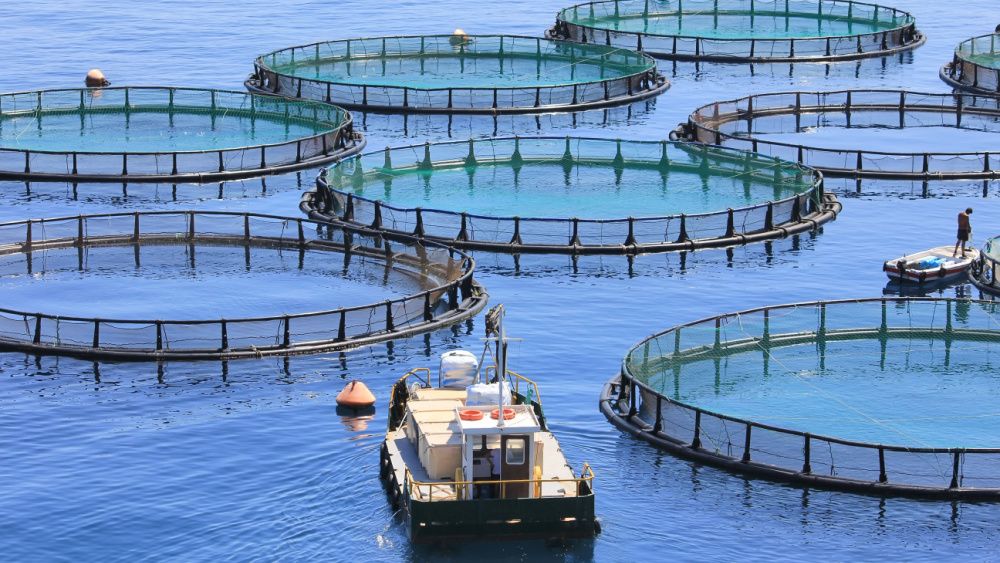
In 2022, 4 EU countries collectively accounted for about two-thirds (67%) of the total production of farmed aquatic organisms: Spain (25%), France (17%), Greece (13%) and Italy (12%).

As in previous years, Norway’s production surpassed that of the entire EU, with 1.66 million tonnes produced, most of which was salmon.
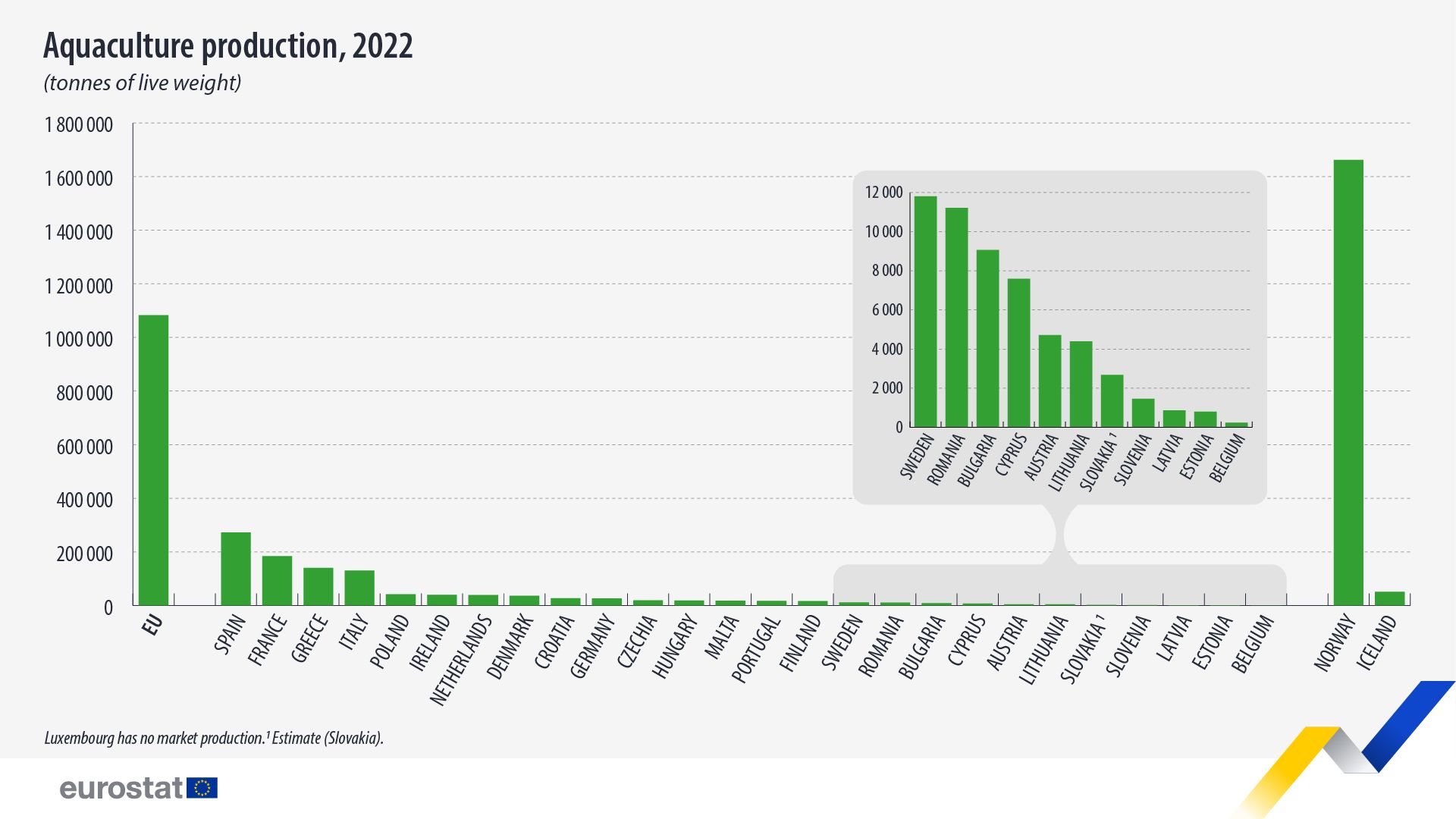
Production in the EU is focused primarily on finfish species (such as trout, seabream, seabass, carp, tuna, and salmon) and molluscs (including mussels, oysters, and clams), which together accounted for almost all of the aquaculture production by weight in 2022.

EU aquaculture in 2021: 1.1 million tonnes farmed

Different aquatic organisms command different prices. The production value of trout (15.1%) and seabass (14.0%) had the highest shares of value for the EU aquatic farming sector.

Fluctuations in production are present due to a variety of reasons, including the fact that some of the species are being bred and grown solely for stocking purposes, some fish species are not harvested yearly, some enterprises trying new species, and the production of some species is being experimental.
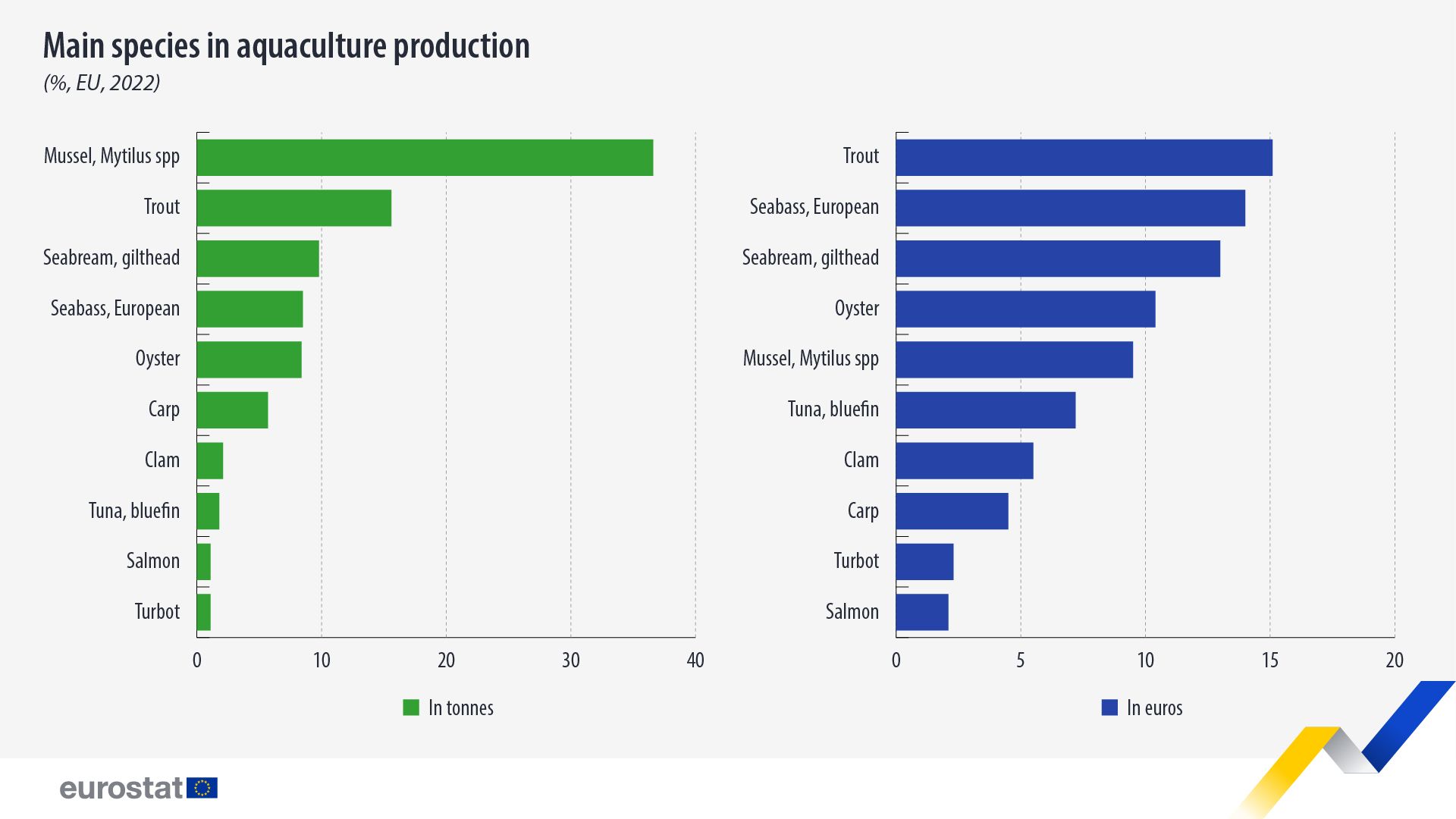
Increased energy prices (due to COVID and war in Ukraine) caused higher production prices, reflected also in selling prices. While production in tonnes remained the same (or even fell in some countries), the total production value in euros climbed higher. Furthermore, some enterprises found it difficult to continue production due to rising costs.

If you want to know more about fluctuations in production or production prices, they are presented in more detail in the Statistics Explained article.

Source: Eurostat

Publicaciones relacionadas:

The Spanish fishing fleet fished more than a fifth of the European Union’s catches in 2022 Spanish team wins Farming by Satellite Prize 2020 September infringement package: main decisions for Spain – Agriculture and Fisheries EU agriculture statistics Commission refers Spain to the Court of Justice of the EU for failure to comply with waste water directive
Agriculture, Livestock Farming and Fisheries,  EU News aquiculture,  European Union,  fish,  production,  Spain

“This is a space for debate. All comments, for or against publication, that are respectful and do not contain expressions that are discriminatory, defamatory or contrary to current legislation will be published”.

Reader Interactions

Leave a Reply Cancel reply

Your email address will not be published. Required fields are marked *

This site uses Akismet to reduce spam. Learn how your comment data is processed.

Primary Sidebar

Footer

  • CDE Almería
  • Biblioteca Nicolás Salmerón – Universidad de Almería
  • Planta: 1ª, Despacho: 1.05.0B.
  • Ctra. Sacramento s/n. Almería (Spain)
  • Teléfono: (+34) 950 015266

HOME
NEWS
DOCUMENTATION
EUROPE ON THE NET
ABOUT US

  • LEGAL NOTICE
  • PRIVACY POLICY
  • COOKIE POLICY
  • ACCESSIBILITY
  • SITEMAP

Copyright © 2026 CDE Almería · Creative Commons LicenseThis work is licensed under a Creative Commons Attribution-NonCommercial 4.0 International License.

<p>El Centro de Documentación Europea de la Universidad de Almería utiliza cookies propias y de terceros para facilitar al usuario la navegación en su página Web y el acceso a los distintos contenidos alojados en la misma. Asimismo, se utilizan cookies analíticas de terceros para medir la interacción de los usuarios con el sitio Web. Pinche el siguiente enlace si desea información sobre el uso de cookies y como deshabilitarlas. </p>

Politica de privacidad

El Centro de Documentación Europea de la Universidad de Almería utiliza cookies propias y de terceros para facilitar al usuario la navegación en su página Web y el acceso a los distintos contenidos alojados en la misma. Asimismo, se utilizan cookies analíticas de terceros para medir la interacción de los usuarios con el sitio Web. Pinche el siguiente enlace si desea información sobre el uso de cookies y como deshabilitarlas. <a href="/politica-de-cookies" rel="noopener" target="_blank">Más información</a>

Cookies estrictamente necesarias

Las cookies estrictamente necesarias tiene que activarse siempre para que podamos guardar tus preferencias de ajustes de cookies.

Básicamente la web no funcionara bien si no las activas.

Estas cookies son:

  • Comprobación de inicio de sesión.
  • Cookies de seguridad.
  • Aceptación/rechazo previo de cookies.
Cookies de terceros

Esta web utiliza Google Analytics, Google Tag Manager y Yandex Metrika para recopilar información anónima tal como el número de visitantes del sitio, o las páginas más populares.

Dejar estas cookies activas nos permite mejorar nuestra web.

Política de cookies

Pinche el siguiente enlace si desea información sobre el uso de cookies y como deshabilitarlas. Más información