
One year after the 2022 summit in Tirana, EU and Western Balkans leaders met in Brussels for their fourth annual summit.

The summit was an opportunity to reaffirm the EU membership perspective of the Western Balkans and also the need for partners’ sustained and irreversible reform achievements, underpinned by EU values and principles.
The main topics of discussion were:
- bringing Western Balkans partners closer to the EU and advancing gradual integration
- building an economic foundation for the future and mitigating the impact of Russia’s war of aggression against Ukraine
- reinforcing security and building resilience
At the end of the summit, the Brussels declaration was issued.
Bringing Western Balkans partners closer to the EU and advancing gradual integration
The EU aims to bring the Western Balkans closer to the EU, preparing the ground for accession, and bringing concrete benefits to their citizens already during the enlargement process.
To this end, the EU intends to explore additional measures aimed at further advancing gradual integration. The EU also underlines the importance of fully using the potential of existing legal instruments.
The EU welcomed the resolve of the Western Balkans partners to respect and commit to core European values and principles in line with international law.
The EU is ready to examine proposals made in the new Growth Plan, recently presented by the Commission, for enhancing the economic integration of the Western Balkans with the EU.
During the summit, EU and Western Balkans leaders took stock of the progress made in various areas such as:
- digital connectivity including the reduction of data roaming costs
- mutual recognition of university diplomas and professional qualifications within the region
- transport and connectivity, including the EU-Western Balkans Green and Blue Lanes
- continued implementation of the Economic and Investment Plan, with €16.6 billion already mobilised
The EU also strongly welcomed the establishment of a new campus of the College of Europe in Tirana and the launch of the application process for the first academic year, 2024-2025.
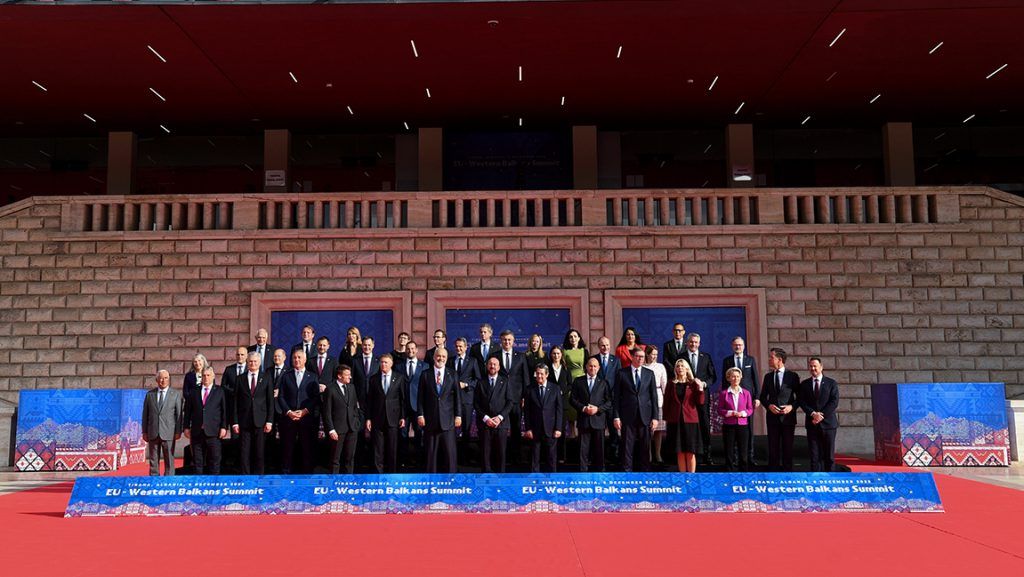
EU leaders and Western Balkans partners reconfirm strategic partnership
|
Building a robust economic foundation for the future and mitigating the impact of Russia’s war of aggression against Ukraine
In order to mitigate the impact of Russia’s war of aggression against Ukraine, the EU is determined to further intensify its political engagement with the Western Balkans region, in addition to the assistance already provided.
The EU will continue its support for the Western Balkan partners in tackling the negative effects on their economies and societies.
The EU recalled its decision to open the EU’s mechanism for joint purchases of gas and LNG for the Western Balkans, and encouraged its use by partners with gas markets, in order to reduce their dependency on Russian gas.
Reinforcing security and building resilience
The summit was an opportunity to discuss coordinated actions on security and defence matters, which have become even more relevant in the context of Russia’s aggression against Ukraine.
This includes fighting foreign information manipulation and enhancing collective cybersecurity.
Background information
The summit is part of the implementation of the EU 2019-2024 strategic agenda.
More information: European Council
Publicaciones relacionadas:
 The European Union and the Republic of Korea advance their strategic partnership at annual Joint Committee meeting
 Statement by President von der Leyen after the trilateral meeting with the President of the People’s Republic of China
 SOTEU 2020: President Von der Leyen sets the course for Europe
 Economic and Investment Plan to support the economic recovery and convergence of the Western Balkans
 EU-US: A new transatlantic agenda for global change
Leave a Reply