
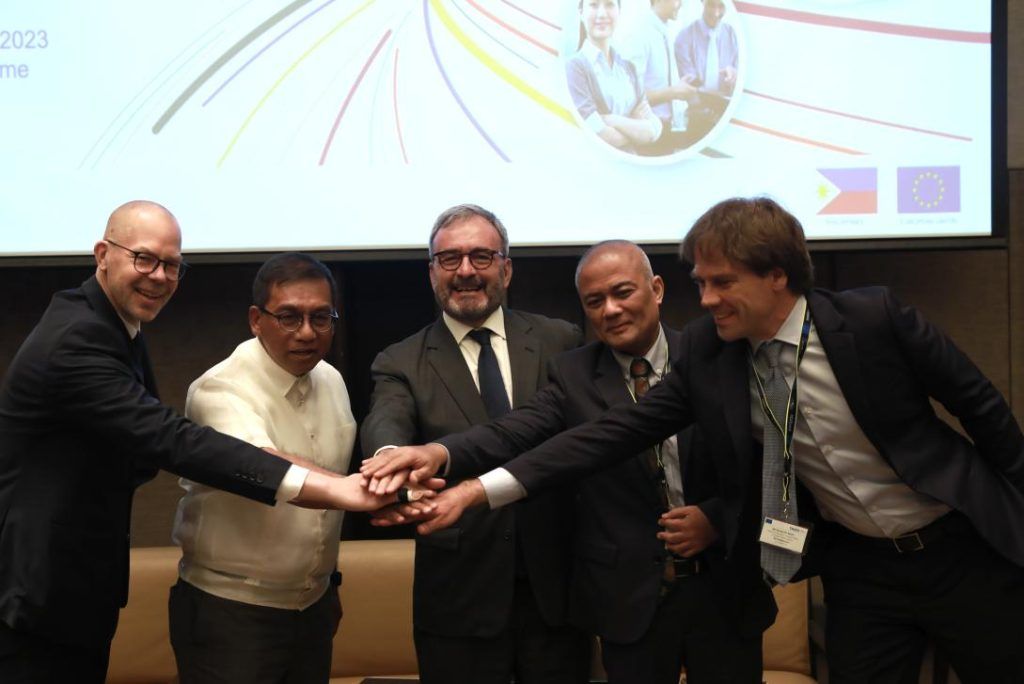
The EU and the Philippines announced their intention to explore the relaunch of negotiations for an ambitious, modern, and balanced free trade agreement (FTA) – with sustainability at its core. The EU and the Philippines will shortly kick off a bilateral ‘scoping process’ to assess to which extent they share a mutual understanding on the future FTA. If this process concludes successfully, and after consultations with the Member States, the EU and the Philippines would be in a position to resume FTA negotiations.

Following the resumption of FTA talks with Thailand earlier this year, this announcement confirms the key importance of the Indo-Pacific region for the EU trade agenda, paving the way for deeper trade ties with another vibrant economy in South-East Asia and further strengthening the EU’s strategic engagement with this burgeoning region.
The EU aims for a comprehensive FTA with the Philippines that includes ambitious market access commitments, swift and effective sanitary and phyto-sanitary procedures, as well as the protection of intellectual property rights, including Geographical Indications. Sustainability will also be at the heart of this agreement, with robust and enforceable disciplines on Trade and Sustainable Development (TSD). These will be in line with the Commission’s TSD review Communication of June 2022, supporting high levels of protection for workers’ rights, for the environment, and the achievement of ambitious climate goals.
The EU and the Philippines already have well-established trade relations, with clear potential for an even closer relationship:
- trade in goods was worth over 18.4 billion euros in 2022, while trade in services was worth 4.7 billion euros in 2021;
- the EU is Philippines’s 4th largest trade partner;
- the Philippines, the 5th largest economy in the ASEAN region, is the EU’s 7th most important trading partner in the region (and 41st worldwide);
- the EU is one of the largest investors in the Philippines, with the EU’s foreign direct investment stock in the Philippines reaching 13.7 billion euros in 2021.
Philippines and EU join forces for better response to natural disasters and climate change |
Background
The Philippines currently enjoy trade preferences under the EU’s Generalised Scheme of Preferences + (GSP+), a special incentive arrangement for sustainable development and good governance which grants duty-free access to the EU market for two-thirds of tariff lines. This enhanced access is conditional on the Philippines implementing a range of international conventions covering issues such as human and labour rights, good governance, and environmental protection. The EU will continue to monitor the Philippines’ compliance with its international obligations in these areas and pursue its ongoing dialogue to encourage further improvement.
The Philippines is among the fastest growing emerging economies in the world, recording the 2nd highest economic growth in ASEAN with 7.6% GDP growth in 2022. This high economic growth exemplifies a promising growth trajectory and increased economic potential for the Philippines as an important trading partner. Moreover, the Philippines has major reserves of critical raw materials, including nickel, copper, and chromite, which are vital for the manufacture of green technologies. Combined with the Philippines’ renewed efforts to harvest its renewable energy potential and recent liberalisation for foreign investors in the sector, the Philippines is an important partner in the green transition.
The EU and the Philippines first launched negotiations for an FTA in 2015. The last negotiating round took place in 2017 and negotiations have since been on hold. On 30 June 2022, the new administration assumed office and has shown willingness to engage with the EU on key issues of importance.
The 2021 EU Indo-Pacific Strategy further confirmed the EU’s longstanding interest in resuming FTA negotiations with the Philippines. The EU already has state-of-the-art FTAs in place with two ASEAN countries (Singapore and Vietnam), is negotiating an FTA with Indonesia, will soon resume FTA negotiations with Thailand, and is currently carrying out a scoping exercise with Malaysia.
More information: European Commission
Publicaciones relacionadas:
 July infringements package: key decisions related to Spain and Environmental matters
 Commission welcomes Joint Statement to provide affordable, accessible and transparent remittance services to Ukraine
 The European Union and Tunisia agreed to work together on a comprehensive partnership package
 EU-US Critical Minerals Agreement
 An EU approach to enhance economic security
Leave a Reply