
The European Commission and the High Representative published a Joint Communication on a European Economic Security Strategy. This Joint Communication focuses on minimising risks arising from certain economic flows in the context of increased geopolitical tensions and accelerated technological shifts, while preserving maximum levels of economic openness and dynamism.
The proposed strategy sets out a common framework for achieving economic security by promoting the EU’s economic base and competitiveness; protecting against risks; and partnering with the broadest possible range of countries to address shared concerns and interests. The fundamental principles of proportionality and precision will guide measures on economic security.
A more comprehensive approach to risk management
Risks presented by certain economic linkages are evolving quickly in the current geopolitical and technological environment and are increasingly merging with security concerns. This is why the EU must develop a comprehensive approach on commonly identifying, assessing and managing risks to its economic security.
The Strategy proposes to carry out a thorough assessment of risks to economic security in four areas:
- risks to the resilience of supply chains, including energy security;
- risks to physical and cyber security of critical infrastructure;
- risks related to technology security and technology leakage;
- risks of weaponisation of economic dependencies or economic coercion.
The Strategy proposes a methodology for this risk assessment. It should be carried out by the Commission and Member States in cooperation with the High Representative, where appropriate, and with input from the private sector. It should be a dynamic and continuous process.
The Strategy also sets out how to mitigate identified risks through a three-pronged approach, namely by:
- promoting the EU’s competitiveness, by strengthening the Single Market, supporting a strong and resilient economy, investing in skills and fostering the EU’s research, technological and industrial base;
- protecting the EU’s economic security through a range of existing policies and tools, and consideration of new ones to address possible gaps. This would be done in a proportionate and precise way that limits any negative unintended spill-over effects on the European and global economy;
- partnering with the broadest possible range of partners to strengthen economic security, including through furthering and finalising trade agreements, reinforcing other partnerships, strengthening the international rules-based economic order and multilateral institutions, such as the World Trade Organization, and investing in sustainable development through Global Gateway.
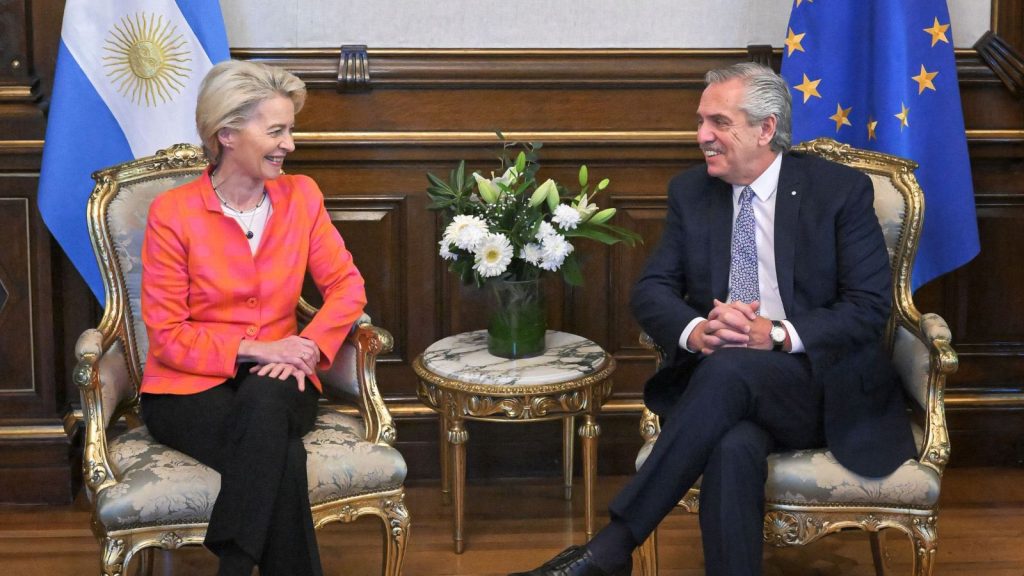
EU and Argentina step up cooperation on raw materials
|
Next steps
The Communication lays the basis for a strategic discussion with EU Member States and the European Parliament to develop a comprehensive approach to protect the Union’s economic security. The European Council will consider the strategy during its meeting of 29-30 June 2023.
The Communication lays out the following new actions:
- develop with Member States a framework for assessing risks affecting the EU’s economic security; this includes establishing a list of technologies which are critical to economic security and assess their risks with a view to devising appropriate mitigating measures;
- engage in a structured dialogue with the private sector to develop a collective understanding of economic security and encourage them to conduct due diligence and risk management in light of economic security concerns;
- further support EU technological sovereignty and resilience of EU value chains, including by developing critical technologies through Strategic Technologies for Europe Platform (STEP);
- review the Foreign Direct Investment Screening Regulation.
- explore options to ensure adequate targeted support for research and development of dual-use technologies;
- fully implement the EU’s export control regulation on dual use items and make a proposal to ensure its effectiveness and efficiency;
- examine, together with Member States, what security risks can result from outbound investments and on this basis propose an initiative by the end of the year;
- propose measures to improve research security ensuring a systematic and rigorous enforcement of the existing tools and identifying and addressing any remaining gaps;
- explore the targeted use of the Common Foreign and Security Policy (CFSP) instruments to enhance EU economic security including Hybrid and Cyber Diplomacy toolboxes and foreign information manipulation and interference (FIMI) toolbox;
- instruct the EU Single Intelligence Analysis Capacity (SIAC) to work specifically on the detection of possible threats to EU economic security;
- ensure that the protection and promotion of EU economic security is fully integrated in European Union’s external action and intensify the cooperation with third countries on economic security issues.
More information: European Commission
Publicaciones relacionadas:
 September infringement proceedings package concerning Spain: main decisions
 EU expands scope of sanctions against Iran
 EU proposes comprehensive new on Climate-Security nexus
 Commission adopts rules for implementing the Foreign Subsidies Regulation
 The European Commission clears the creation of a joint venture between Iberdrola and BP
Leave a Reply