
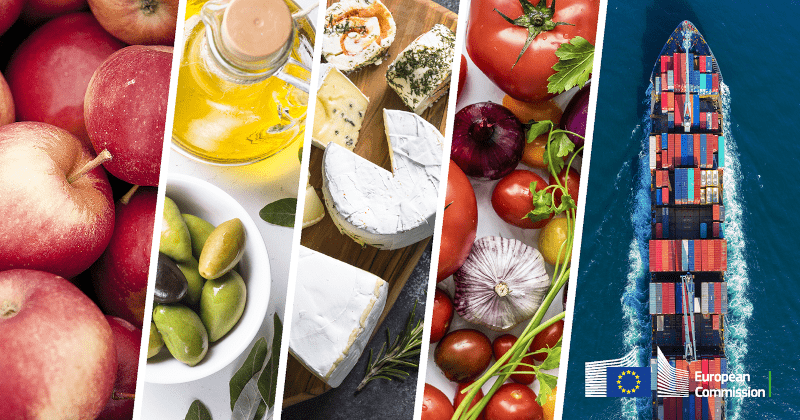
EU agri-food trade balance reached its record level in 2023, according to the latest report published by the European Commission. After a good performance of the EU agri-food trade in 2022, the most recent report released by the European Commission indicates that the EU agri-food trade balance reached its record level in 2023. EU exports reached €228.6 billion, with EU imports at €158.6 billion in 2023, resulting in a total surplus of €70.1 billion (+22% and €12.8 billion higher than in 2022). This positive balance is mainly due to sustained high prices for EU export products paired with declining world prices for imported products. Key drivers of EU exports included cereal preparations, dairy products, and wine. Regarding imports, the EU continues to experience a trade deficit in certain product categories such as oilseeds and protein crops, fruit and nuts and coffee, tea, cocoa, and spices. With its renowned quality, competitiveness and high level of diversification, the European Union remains the top global trader of agri-food products.
Exports
EU agri-food exports reached €228.6 billion in 2023. The EU trades with a large number of countries, with the United Kingdom (UK) being the top destination for EU agri-food exports, accounting for 22% (€51.3 billion). The United States (US) remains the second destination of all EU agri-food exports, even though there was a slight decrease of EU exports there, in particular for spirits and liqueurs. China is still the third destination absorbing 6% of all EU agri-food export value. However, exports of pigmeat to China decreased by 29% in 2023. EU agri-food exports to Türkiye (+€683 million, +7%) and Ukraine increased (+€533 million, +18%). Overall, EU agri-food trade remained diversified with an important number of partner countries.
In 2023, the EU exported a wide variety of products, with the top 3 exported product categories by the EU representing close to 30% of total EU agri-food exports. These top three categories were cereal preparations and milling products; dairy products; and wine and wine-based products. Exports of preparations of fruit, nuts and vegetables had the largest increase in value in 2023, with +€1.3 billion (+12%) compared to 2022. It is followed by exports of cereal preparations and milling products (+€1.2 billion, +5%) and confectionary and chocolate (+€1.2 billion, +12%).
Imports
EU agri-food imports decreased by 7% in 2023, reaching €158.6 billion. This evolution of the value of EU agri-food imports is related to the evolution of prices of products imported.
Brazil remained the first source of origin, representing 11% of EU agri-food imports in 2023. The UK was the second source, with imports remaining stable. Ukraine remained the third source, with a value of €11.8 billion and 7% of EU imports. The evolution of imports from Ukraine in 2023 has been contrasted across products, but overall, imports level has gone back to 2021 level towards the end of the year. Overall, the top three origins of EU imports represented 28% of total imports, while the EU imported € 1 billion or more from 30 countries, which shows the level of country diversification in EU agri-food imports.
Among other significant evolutions, the largest increase in imports was from Türkiye (+€999 million, +18%) followed by Egypt +€566 million, +41%). Other significant changes were observed with decreases from Argentina (-€2.3 billion, -33%), China (-€1.5 billion, -15%), and Indonesia (-€1.3 billion, -19%).
In 2023, the EU continued to import mostly three categories of products that represented 40% of total EU agri-food imports: (1) fruit and nuts, (2) oilseeds and protein crops and (3) coffee, tea, cocoa and spices. These categories represent between €21 and €22 billion, accounting for 13% to 14% of EU imports. The largest increases in import value in 2023 were for tobacco products (+€1 billion, +27%) and vegetables (+€793 million, +16% in value).

International trade in chocolate in 2023 |
More information: European Commission
Publicaciones relacionadas:
 Commission helps resume trade in European pork and poultry to the Republic of Korea
 Competitive EU agri-food sector achieves high level of diversification in trade
 EU food prices: olive oil up 75% since January 2021
 EU wins WTO compliance action against US in ripe olives dispute
 Main results of the Foreign Affairs Council (Trade) – 3 June 2022
Leave a Reply