
One of the Czech Republic’s top priorities during its six months in the chair of the Council of the European Union will be to cope with the influx of displaced Ukrainians forced to flee because of Russia’s invasion, Deputy Prime Minister Ivan Bartoš told the European Committee of the Regions on 30 June. He also pledged to try to make it easier for regions and cities to secure EU funding for the support of refugees and speed up the transition towards safe and sustainable energy.

Outlining the Czech priorities for its Presidency, Deputy Prime Minister Bartoš focused on the consequences of Russia’s war against Ukraine, highlighting the need to end the EU’s dependence on Russian fuel, to address the worsening problem of energy poverty in Europe, and to prepare to help Ukraine’s reconstruction. He also emphasised that “the fight against disinformation, cyber and hybrid war” would be a “high priority”.
Noting that the first Czech Presidency in 2009 was marked by an energy crisis in Europe caused by Russia’s decision to halt supplies to Ukraine, Deputy Prime Minister Bartoš said: “The Ukrainian crisis is here again and it is worse, and it is triggered by a war started by Russia. Our first priority is to cope with the refugee crisis. We will look at how to help the most vulnerable and most affected. We will look to make finances more flexible. We cannot be dependent on countries that directly endanger our future; energy poverty has become a real threat in all EU member states. We will also want to contribute to post-war reconstruction, because the stability of Ukraine is crucial for the future.”
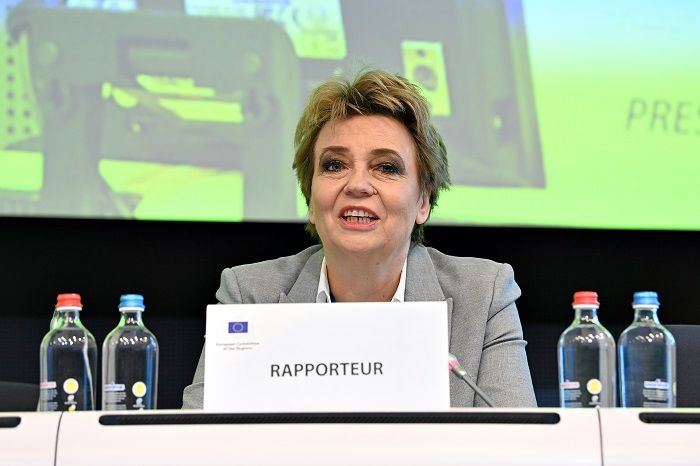
The EU’s ecological transition must be grounded on a strong social acceptability |
The President of the European Committee of the Regions, Vasco Alves Cordeiro (PT/PES), member of a Regional Parliament of the Azores, s peaking a day after his election, said: “The Committee of the Regions welcomes the Czech Presidency ’s will to strengthen the voice of regions and cities in the EU. The Czech Presidency starts in a critical moment for our Union. A war on our continent, the pandemic: cities and regions have been at the forefront to mitigate the consequences. Let’s work together to make our Union stronger, fairer and more sustainable.”
Deputy Prime Minister Bartoš, who is also Minister for Regional Development, said that the Czech Presidency would also launch a political debate on the future of cohesion policy, with an outcome in November at the level of national ministers. He praised cohesion policy as a policy that “brings the EU closer to its citizens”, that “has its own value” and helps to improve public governance. He indicated that the objective would be to ensure that cohesion policy is a “strategic development strategy for the regions of the EU”. The Prime Minister also outlined energy transition as a top priority in order to face the energy crisis and continue protecting vulnerable citizens.
Shortly before Deputy Prime Minister Bartoš spoke, Zdeněk Hřib (CZ/Greens), mayor of Prague, said that it was “vital for the EU to financially support cities more” as they seek to help refugees “not just to feel safe”, but also to realise their potential. Per capita, Czechia is one of the countries hosting the highest number of Ukrainian refugees.
Policies on which the EU’s member states are likely to see the opinions of the EU’s regions and cities – via the European Committee of the Regions (CoR) – during the Czech Presidency cover topics ranging from the reconstruction of Ukrain e, the transition to a fair, sustainable and secure energy and the future of the Eastern Partnership to support for a green energy transition in coal- and energy-intensive regions, and housing rentals. Hours after Deputy Prime Minister Bartoš spoke, the CoR, six European and four Ukrainian associations for regions and cities launched an alliance to support the reconstruction of Ukraine. The Alliance was formed at the request of Ukrainian President Volodymyr Zelenskiy, with the support of the presidents of the European Council and European Commission.

ECB takes further steps to incorporate climate change into its monetary policy operations
|
Among the events on which the European Committee of the Regions and the Czech Presidency are collaborating are a meeting of the CoR’s political leadership focused on support for Ukraine (Prague, September) and meetings with cities and regions from would-be members of the European Union (Brussels, July) and from Ukraine and other countries in the Eastern Partnership (Liberec, November). They are also working together on the role of cities and regions in tackling climate change, tied to events in September and October leading up to the United Nations’ COP27 global climate talks, while the social implications of decarbonisation will be addressed in a joint CoR-Czech Presidency conference on a ‘just transition’ for coal regions (November). Regional development will also be a focus, with a conference and study visit in Prague on urban mobility (July), events at the European Week of Regions and Cities (October), and a seminar on smart villages in Lednice (October).
Source: European Committee of the Regions – Press release
Publicaciones relacionadas:
 International Women’s Day 2020: Beijing Declaration 25 years after
 EU-UK future relations: crucial to ensure EU leverage and unity
 Statement of the Foreign Affairs Council about the crisis in Idlib and the situation at the EU external borders with Turkey
 Efficient contact tracing applications to support the lifting of confinement measures
 COVID-19: EU emergency measures to help farmers and fishermen
Leave a Reply