
The European Commission Representation in Spain organised the second annual conference on the Spanish Recovery, Transformation and Resilience Plan. The event took stock of the Plan, analysing the opportunities it offers to achieve a greener, more digital and resilient Spain, as well as the challenges for its implementation.
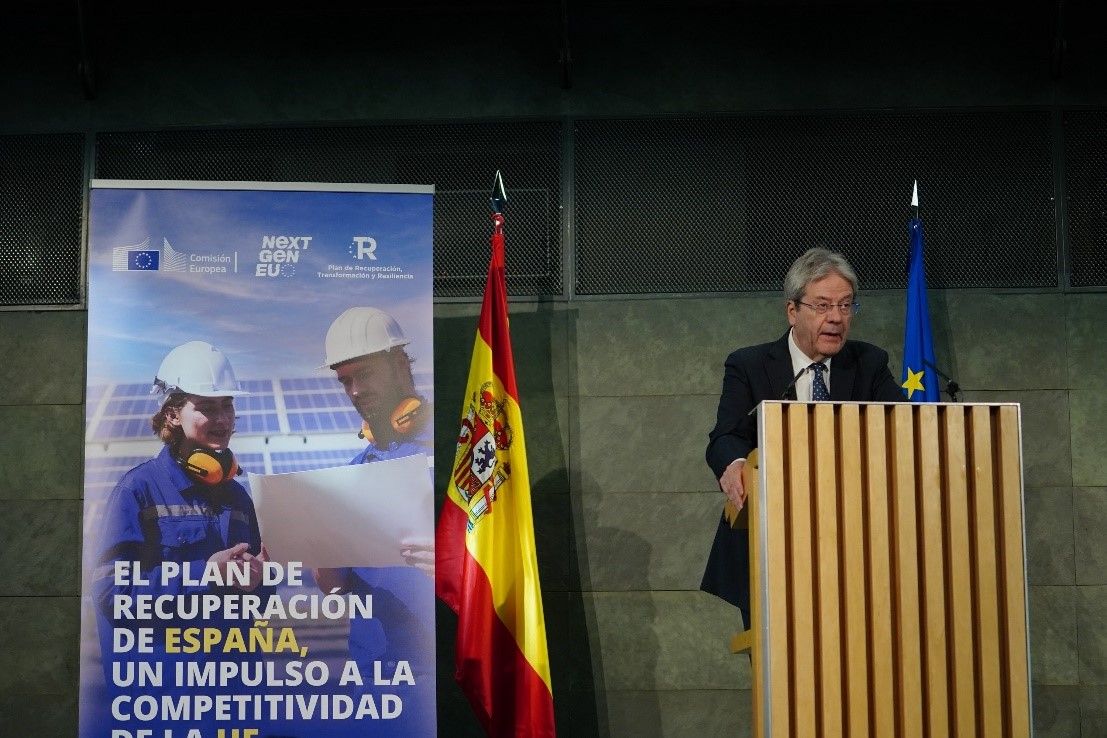
The event was opened by the acting director of the European Commission Representation in Spain, Lucas González, the Minister of Economy, Trade and Enterprise, Carlos Cuerpo, and the European Commissioner for the Economy, Paolo Gentiloni. Lucas González and the European Commission’s Executive Vice-President for the Economy at the Service of People, Valdis Dombrovskis, in video, closed the event.
The conference brought together representatives from all levels of government and administration, social agents, civil society, companies, experts and representatives of the academic world, distributed in three round tables.
The first round table was entitled Accelerating the green transition in Spain. It reflected on the challenges and opportunities offered by the NextGenerationEU funds to accelerate decarbonisation in Spain, especially in key sectors such as energy and industry. The speakers also took stock of the reforms and investment strategies developed by Spain in its Recovery Plan on its way to achieving the national climate targets and its European contribution.
The second round table was entitled Boosting the competitiveness of industry in Spain and Europe. In it, representatives of the Ministry of Economy, the European Commission, employers and trade unions assessed the contribution of European funds to the strategic autonomy of Spain and Europe, and their role in the growth of the real economy in this context of crisis.
The third round table was organised under the title Accelerating the implementation of the revised plan. Spanish and European authorities, heads of regional and municipal governments, the president of the Instituto de Crédito Oficial, as well as beneficiaries of European funds shared their thoughts on the implementation of the revised Plan, analysing the challenges and opportunities to ensure its full exploitation.
Monitoring visit of the implementation of the Recovery Plan from 13 to 15 March
The annual conference is part of a visit to Spain by the Recovery and Resilience Task Force and the European Commission’s Directorate-General for Economic and Financial Affairs to monitor the implementation of its Recovery and Resilience Plan. During these days, they had the opportunity to meet with Spanish authorities, the Joint Commission for the European Union of the Spanish Congress of Deputies, social partners and civil society to discuss the implementation of the Recovery and Resilience funds. They also visited a project funded by the Spanish Recovery Plan in the field of aeronautics. Since October 2021, annually the European Commission carries out a mission to monitor the implementation of the Plan in the Member States.
Quotes:
Spain has already achieved a lot with its Recovery Plan. It has implemented reforms that are paving the way towards a more competitive and innovative economy and a more inclusive society. It is making key investments in the digital and green transitions and in boosting competitiveness. But there are also some important challenges ahead. Spain must accelerate its planned national and regional investments and rally support in reform areas such as taxation, industry, water management and social protection. I encourage Spain to keep regional authorities and social partners closely involved at every stage of the Plan’s implementation and to preserve the progress achieved so far. The success of the Recovery and Resilience Mechanism is not only vital for future generations in Spain, but also for the European Union as a whole. Valdis Dombrovskis, European Commission Executive Vice-President for the Economy at the Service of People.
Spain has been a pioneer in the implementation of the RRM: it was one of the first countries to present its recovery plan and obtain approval for it, and the first to receive a payment, at the end of 2021. The Spanish plan is also one of the most ambitious: after last year’s revision, it now amounts to EUR 163 billion, equivalent to 12% of GDP. In order to maximise the absorption of these funds, it will be important to continue to strengthen administrative capacity; close coordination between levels of government; and effective communication on funding opportunities. The European Commission will continue to be a constructive partner for Spain between now and 2026 in its efforts to make the most of this extraordinary opportunity. Paolo Gentiloni, European Commissioner for Economic Affairs.
The transformation of the Spanish economy is being achieved thanks to the Spanish Recovery Plan and its implementation is high and balanced. Around EUR 32.5 billion, almost half of the NextGenerationEU funds of the first phase of the Plan, have been resolved and have already reached the real economy. This is a country project, but it is part of a European response towards common goals. We must use the lessons of the Plan to advance the European project. Carlos Cuerpo, Minister of Economy, Trade and Enterprise.
The opportunities offered by the Recovery and Resilience Mechanism for Spain as an engine for economic growth and as an innovative instrument linked to the implementation of investments and reforms are indisputable. The organisation of this annual event, in its second edition, allows us to approach many expert voices involved in the design and implementation of the Spanish Recovery, Transformation and Resilience Plan, as well as to give visibility to many of its projects. Lucas González, Acting Director of the European Commission Representation in Spain.
More information
Website of the Representation of the European Commission in Spain.
Spanish Recovery and Resilience Plan.
Publicaciones relacionadas:
 EU Cohesion Policy: €37.3 billion to Spain
 European Commission signs agreement with ICO to invest €150 million in sustainable infrastructure in Spain
 European Commission approves third €6 billion payment to Spain under the Recovery and Resilience Mechanism
 European Commission approves €460M aid to ArcelorMittal Spain to support decarbonisation of its steel production
 Commission approves second Spanish “umbrella” scheme to support economy in coronavirus outbreak
Leave a Reply