
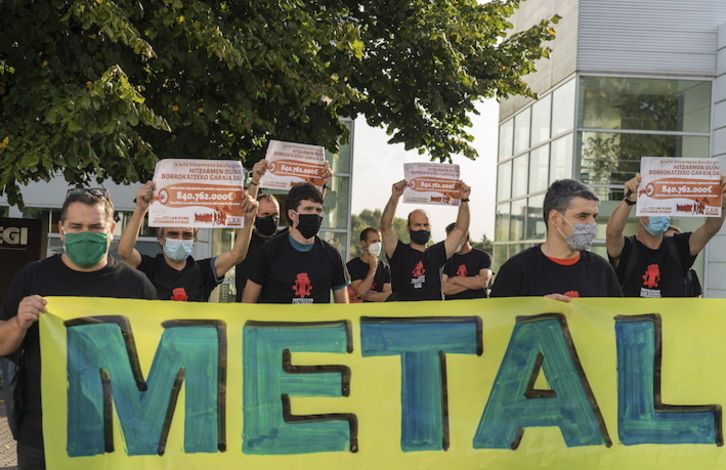
Today, the Commission proposes to support 300 former workers in the metal sector in the Basque region in Spain, who lost their jobs due to the COVID-19 pandemic. The proposed €1.2 million from the European Globalisation Adjustment Fund for Displaced Workers (EGF) will help these workers find new jobs through further education or training, or to start their own business. This is the first application of the EGF under the new regulation for 2021-2027.
Commissioner for Jobs and Social Rights, Nicolas Schmit, said: “The economic crisis caused by the COVID-19 pandemic has hit many people and industries hard. Today the EU is showing solidarity to 300 former workers in the metal sector in the Basque region in Spain, by making available €1.2 million from the EGF. This money will help those affected workers find new jobs with additional skills, or to start their own business. In times of crisis it is of utmost importance that we invest in people.”
As a consequence of the COVID-19 pandemic, in 2020, a third of all enterprises manufacturing fabricated metal products in Spain experienced a decrease between 30% and 50% of both production and turnover, compared to the previous year. Thanks to the EGF, 300 workers laid off from Basque businesses in this sector will receive targeted active labour market support to help them return to work.
The €1.2 million in support from the EGF will help the Basque authorities finance measures ranging from career guidance and individualised job-search support, to acquiring new or additional skills, vocational and on-the-job training, and support and funding to start an own business. Training will also help improve digital skills and therefore contribute to the digital transition in the metal industry. Participants can receive allowances for participating in these support measures.
The total estimated cost of the support measures is €1.4 million, of which the EGF will cover 85% (€1.2 million). The Basque public employment service (Lanbide) will cover the remaining amount. Lanbide has already begun offering support to the displaced workers.
The Commission’s proposal requires approval by the European Parliament and the Council.
Background
In the second quarter of 2020, Spain introduced strict lockdown measures necessary to contain the COVID-19 pandemic. This has had a significant impact on the activity and turnover of the businesses operating in the manufacture of fabricated metal products sector, with negative consequences on employment and on the liquidity of businesses.
In the Basque region, the fabricated metal products sector represents around a quarter of the gross value added of the industry. Unemployment in the Basque region, especially in the metal sector, started increasing dramatically since March 2020. In August 2020, 25% more people were unemployed than six months earlier. Job losses in the industry sector have been greater than in all other sectors together.
In this context, the regional authorities expect that, unless they receive additional and personalised support, most displaced workers will have great difficulties in finding new jobs, especially older workers and workers with a low level of education.
Under the new EGF regulation 2021-2027, the Fund continues to support workers and self-employed whose activity has been lost. The new rules allow supporting more people affected by restructuring events: all types of unexpected major restructuring events can be eligible for support, including the economic effects of the COVID-19 crisis, as well as larger economic trends like decarbonisation and automation. Member States can apply for EU funding when at least 200 workers lose their jobs within a specific reference period.
Since 2007, the EGF made available some €652 million in 166 cases, offering help to more than 160 000 workers and more than 4 400 young people not in employment, education or training in 20 Member States. EGF supported measures add to national active labour market measures.
For More Information
Commission proposal for EGF support to dismissed workers in the Basque metal sector
Publicaciones relacionadas:
 EU and AU sign partnership to scale up preparedness for health emergencies
 New EU-UK agreement is welcome but thorough scrutiny remains, insist lead MEPs
 Towards a sustainable EU recovery by strengthening the SDGs
 Updating EU rules on teleworking stirs up debate in EESC hearing
 Brussels demands confinement of Spain
Leave a Reply