
Europe is a world-class leader in the production of robots, for example, one fourth of industrial robots in the world are produced in Europe!
This industry plays a key role in the digital transformation of our societies and economies that, combined with Artificial Intelligence (AI), will likely have a tremendously disruptive effect.
Robots can be used to support humans in the performance of tedious, dangerous or hazardous tasks, they can help us increase our societal welfare and enhance the way we learn, allowing us to develop our potential to the maximum.
The European Commission is striving to grasp the opportunities offered by the digital transformation to improve the EU economy: robotics is a flagship sector, in which Europe must keep its competitive advantage while guaranteeing technological sovereignty and remaining strictly compliant with our social and ethics values.
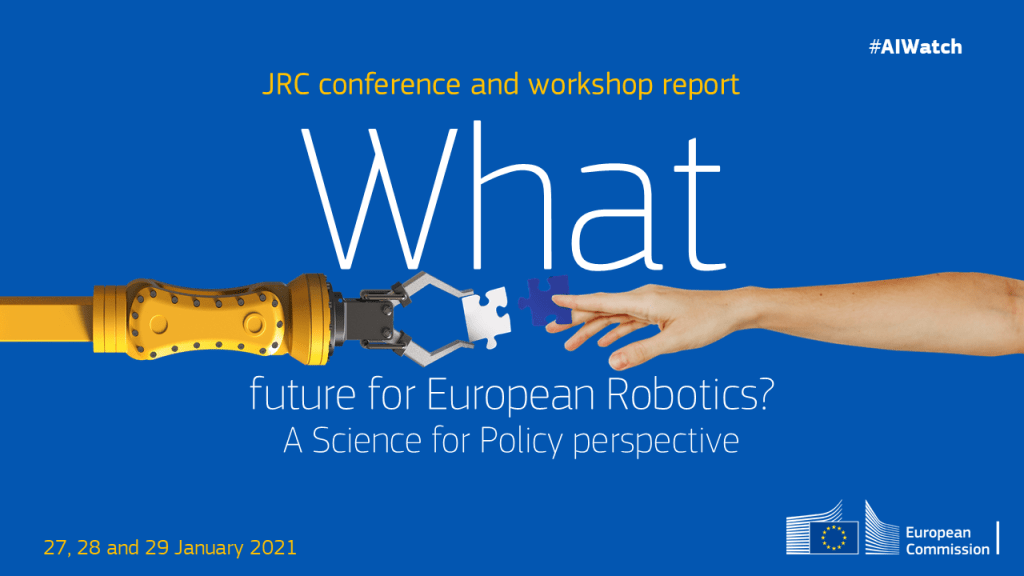
According to the recently published report of the conference “What future for European Robotics?” organised by the European Commission’s Joint Research Centre earlier this year, a decisive, agile, horizontal, coordinated and multidisciplinary public intervention is needed to maximise the benefits of robotics, address its challenges and minimize the negative effects.
Commissioner for Innovation, Research, Culture, Education and Youth, Mariya Gabriel, in her a keynote speech at the conference said: “We expect robots to help our societies in achieving successfully the digital and green transitions and they are expected to have a concrete and direct impact on the daily lives of all the citizens (…). We need evidence-based policy in this field to understand the impact of robot interventions on human behaviour. We need to advance in our understanding and know-how on machine learning, artificial intelligence, computer science, computer vision, and complex robot control systems.”
Vice-President for Interinstitutional Relations and Foresight, Maroš Šefčovič, in his keynote speech said: “The European Union has long been a global leader in the research and development of robotics and AI. Robotics can make our industry more competitive and sustainable, while helping to solve major societal challenges (…). Making the most of new technologies, not least in the field of AI and robotics, is paramount if we are to overcome the challenges – and make the most of the opportunities – which stand before us.”
Key take-away from the conference
The European Commission is coming forward with a broad portfolio of policy initiatives to ensure that no one is left behind, and to set-up an adequate legal framework. Robotics was placed among the main priorities in the review of the Coordinated Plan on Artificial Intelligence, while the horizontal regulation on Artificial Intelligence proposes conditions for the use of high-risk AI applications.
Additionally, the proposal for a Regulation on machinery products – a centrepiece legislation for safety of robots in the EU – enhances requirements for new emerging autonomous robots.
Robotics could also be key for the post-pandemic recovery in the EU, if we make sure to support regional innovation, start-ups, stronger involvement in the public sector, and ensuring a competitive advantage.
Among the recommendations included in the report – which are the results of a three-day series of discussion among leaders in industry, academia and policy-making –the need for robot design and development to comply with human rights is mentioned, as well as to keep humans in command, and to foresee measures against any negative environmental impact.
The advice given to policy-makers is to ensure that ethical technology assessments are carried out before deploying AI/robotics technology, and to consider a regulatory framework to minimise risks for children during social child-robot interaction.
This is already reflected in other Commission’s initiatives like the revision of the Machinery Directive, focusing on various elements like robot safety, human-machine interaction and transparency, or the Product Liability Directive, in which rules for compensation to customers to whom damage has been caused from the use AI and robots will be further clarified.
Watch the main takeaways of the Conference:
More information
Publicaciones relacionadas:
 Waging war against SARS-CoV-2 with Europe’s most powerful supercomputers
 EIC-EIT: working closer together for Europe’s innovators
 UAL and Nostoc Biotech study on the efficacy of earthworm humus on the productivity and quality of peppers
 Scientists solve mysteries of the world’s oldest computer
 Commission mobilises €123 million for research and innovation to combat the threat of variants
Leave a Reply