
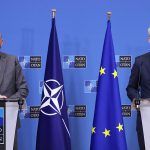
On 3 February a meeting took place at the Egmont Palace (Brussels, Belgium) between António Costa (President of the European Council), Ursula von der Leyen (President of the European Commission), Mark Rutte (NATO Secretary General) and Keir Starmer (Prime Minister of the United Kingdom). At the event, several relevant aspects of current political affairs were discussed, but one was of particular importance: how to strengthen European defence in response to current security challenges.
“In 2022, at the Versailles summit, we decided that we must take more responsibility for our own defence. Much progress has been made, but we need to do more. We need to be better, stronger and faster, and we need to do it together”, the President of the Council opened his remarks at the press conference following the informal brainstorming session.
He highlighted specific elements that were identified as necessary to achieve coherent work between the European Defence Agency and NATO:
- Air and missile defence, as well as the missile and ammunition arsenal itself;
- Military mobility;
- Strengthening the European defence industry in quantity and speed;
- Increasing the defence budget (which has already grown by 30% between 2021 and 2024, with each EU member country simultaneously belonging to NATO spending on average 2% more);
- Public and private investment (for which the European Investment Bank is already taking action).
- Continue joint work with NATO and EU partners.
On the latter, he made special mention of relations with the US, of which he stressed the deep roots of the existing relationship, as well as the values and principles built together since the Second World War: “national sovereignty, territorial integrity and inviolability of borders”. He also made reference to the UK, about which he said: “there is a new positive energy in our relations”.
On Ukraine the President said: “We remain firmly committed to Ukraine’s security and to a comprehensive, just and lasting peace. We Europeans have already supported Ukraine to the tune of 134 billion euros, and we will continue to do so, because we are determined to support Ukraine for as long as it takes and at whatever cost.
The conclusion he drew from his remarks after the conference was not to hypothesise about whether or not to improve European defence, but how to do so.
The full statements can be found on the European Council’s website, provided below in the More information section.
For her part, Roberta Metsola (President of the European Parliament) yesterday expressed the same lines on improving European security and defence. Some of them are as follows:
“Russia can still produce more weapons in three months than we can in twelve. We need to do more, much more, to accelerate defence production and increase our defence industrial readiness. We can do all this while respecting the constitutional specificities of the Member States. The best investment in European security is to invest in Ukraine’s security.
“The real incentive lies in addressing fragmentation within our markets. Different rules, standards and systems put barriers in our way and risk holding us back. It makes no sense for Europe to have 178 different weapons systems when the US has 30.
“Fragmentation costs us billions: between 25 and 75 billion euros are lost through duplication and inefficiencies. The answer to this is staring us in the face. Now is the time to move towards a single defence market”.
“Defence – Trade – Political Reality. Expectations of us are high. We must be prepared to respond. Effectively, forcefully and even drastically. Europe must be responsible for its own security. No one will do it for us“
You can find the full statements on the European Parliament’s website, provided below in the More nformation section.
Further information:
Publicaciones relacionadas:
 Charles Michel: Europe’s values, freedom and democracy will prevail
 EU starts delivery of more than 90 off-road trucks to support Ukraine’s Armed Forces
 Russia’s aggression against Ukraine: the EU targets additional 54 individuals and 10 entities
 Foreign Affairs Committee calls for strengthened EU defence of European security
 EU and NATO sign a new joint declaration on cooperation
Leave a Reply