
Global-mean surface air temperatures for the first days of June 2023 were the highest in the ERA5 data record for early June by a substantial margin, following a May during which sea-surface temperatures were at unprecedented levels for the time of year.
Also in May, the World Meteorological Organization published a report highlighting a 66% likelihood that the annual average global temperature in 2023-2027 would be more than 1.5°C above pre-industrial levels for at least one year. So, did we in fact witness a rise in the global-mean temperature to over 1.5⁰C above the 1850-1900 level in early June?
In December 2015, the nations of the world adopted the Paris Agreement, under which they would pursue efforts to limit the rise in the climatological average global temperature to 1.5⁰C above pre-industrial levels. As it happens, a strong El Niño was close to its peak at the time, and it is now estimated that for a few days the global-mean temperature was more than 1.5⁰C higher than the pre-industrial temperature for the month. This was probably the first time this had occurred in the industrial era.
As the current El Niño continues to develop there is good reason to expect periods in the coming twelve months during which the global-mean air temperature again exceeds pre-industrial levels by more than 1.5⁰C. What’s more, according to the WMO report mentioned above, there is a 98% likelihood that at least one of the next five years, and the five-year period as a whole, will be the warmest on record, and a 32% chance that the five-year mean will exceed the 1.5°C threshold.
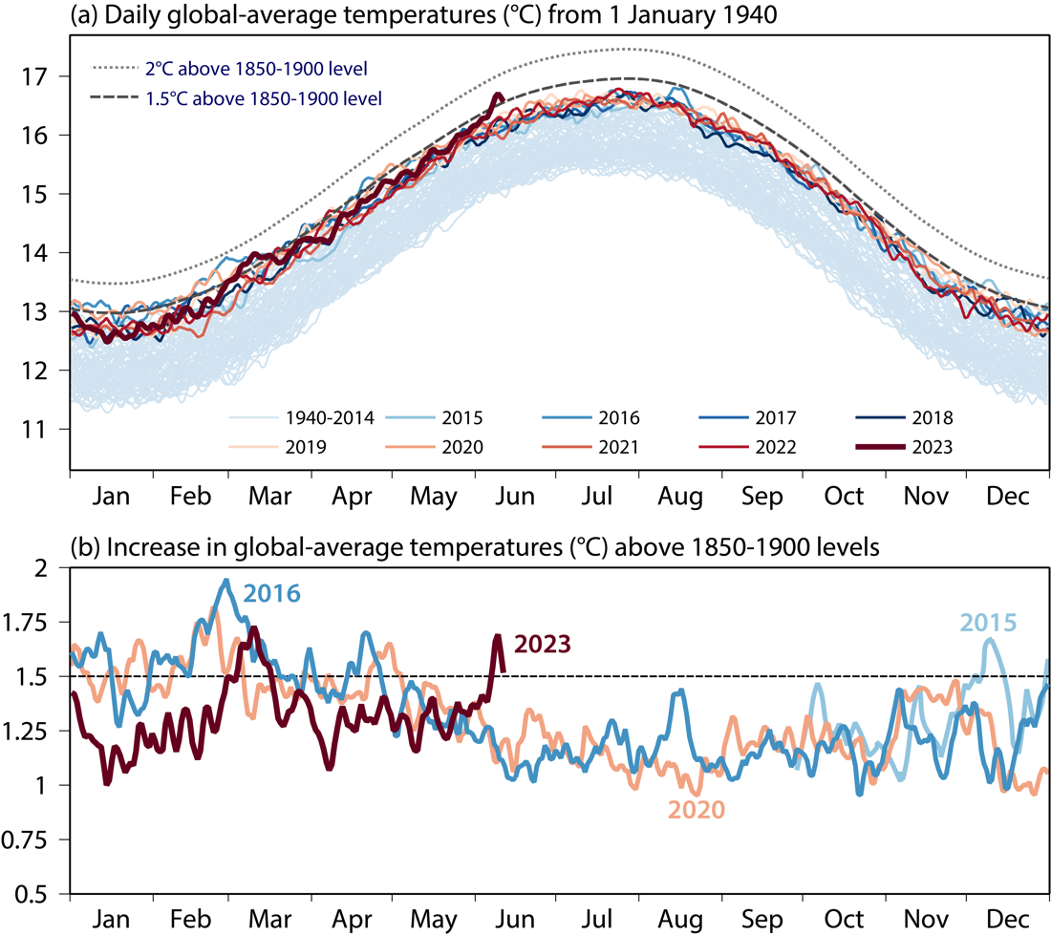
The global-mean temperature figures provided by ERA5 reveal remarkable global warmth in early June 2023. In the figure below, we can see that the global-mean temperature indeed breached the 1.5⁰C limit in the first week of June. However, it remains to be seen how often, for how long and by how much the limit is exceeded in the coming twelve months or so, as the current El Niño completes its cycle.
It must be stressed that the 1.5⁰C and 2⁰C limits set in the Paris Agreement are targets for the average temperature of the planet over the twenty or thirty-year periods[1] typically used to define climate. The impacts of a warming climate nevertheless vary considerably with season and location, and passing the long-term global limits at any one time of year or any one place may not be of particular significance. However, as the global-mean temperature continues to rise and more frequently exceed the 1.5⁰C limit, the cumulative effects of the exceedances will become increasingly serious and must be carefully monitored to keep track of how rapidly we are closing in on the long-term thresholds.

EU responses to climate change |
The data are clear
How do the early June 2023 temperatures fit into the historical record? This is not the first time that global temperature rises have exceeded the 1.5⁰C level. Panel (a) above shows annual time series of daily ERA5 global-mean surface air temperatures from 1940 onwards. Levels that are estimated to be 1.5⁰C and 2⁰C above 1850-1900 reference levels are indicated. The first time in this time series where a monthly average appears above the 1.5⁰C level was in December 2015. Panel (b) complements the information in Panel (a) and shows more clearly the temperature differences for 2016, 2020 and parts of 2015 and 2023 as compared to 1850-1900 values. 2016 and 2020 are the two warmest calendar years in the data record, and the two years prior to 2023 with the most conspicuous occasional breaches of the 1.5⁰C limit.
Exceeding 1.5⁰C has typically occurred in the boreal winter and early spring, most notably in February and March 2016. This is the time of year when the rise in temperature since 1850-1900 has been largest. Seasonality is particularly evident over and close to the Arctic Ocean, where substantial winter warming of the atmosphere has occurred over regions where ice cover has been lower in recent years, and summer warming has been inhibited by the seasonal melting of sea ice, which keeps temperatures close to 0⁰C. Other factors also play a part but, regardless of cause, the larger warming in boreal winter and early spring makes exceedance of the limit more likely at this time of year, especially when temperatures have been temporarily enhanced by an El Niño. Conversely, the temperature limit is generally further from being exceeded in boreal summer. The warm period at the beginning of June 2023 is an exception.
How will Arctic coasts be affected by global warming in 2100? |
Keep track of rising temperatures
C3S has developed an app to help you keep track of global temperatures and their rise towards global warming of 1.5°C. This application monitors the evolution of the global surface air temperature over recent decades until the present, and estimates with a simple model (using a 30-year linear trend) the level of global warming at the date up to which the trend is calculated and the date when global warming will reach the 1.5°C limit of the Paris Agreement if the trend continues at that same rate.





Leave a Reply