
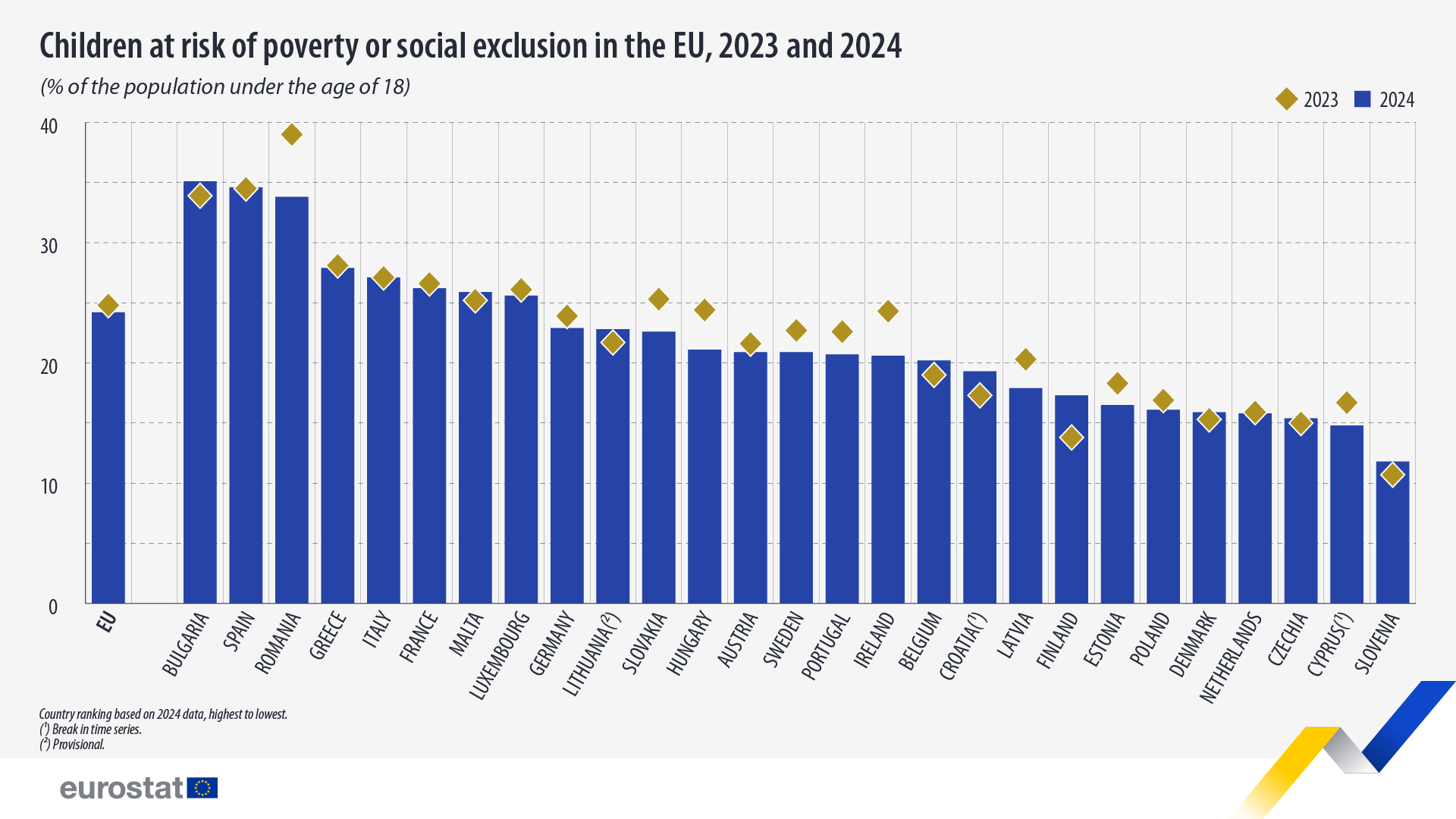
In 2024, 19.5 million children in the EU were at risk of poverty or social exclusion. This figure represented 24.2% of children under the age of 18, down by 0.6 percentage points (pp) from 2023 (24.8%).
At the country level, in 2024, the highest values were reported in Bulgaria (35.1%), Spain (34.6%) and Romania (33.8%). In contrast, Slovenia (11.8%), Cyprus (14.8%) and Czechia (15.4%) registered the lowest shares.

Compared with 2023, Romania registered the largest decrease in the share of children at risk of poverty or social exclusion in 2024, -5.2 pp, followed by Ireland (-3.7 pp) and Hungary (-3.3 pp). On the other hand, Finland (+3.5 pp), Croatia (+2.0 pp), Bulgaria and Belgium (both +1.2 pp) observed the largest increases.
In 2024, the proportion of children at risk of poverty or social exclusion in the EU was 24.2%. At national level, the highest rates were observed in Bulgaria (35.1%), Spain (34.6%) and Romania (33.8%). On the other side, the lowest rates were recorded in Slovenia (11.8%), Cyprus (14.8%) and Czechia (15.4%).
Other graphs hosted by Eurostat show the following data:
The percentage of children at risk of poverty or social exclusion slightly decreased between 2023 and 2024
At the EU level, between 2023 and 2024, the percentage of children at risk of poverty or social exclusion decreased by 0.6 percentage points (pp), from 24.8% to 24.2% (Figure 1).
At the national level, Finland recorded the highest rise, with an increase of 3.5 pp, followed by Croatia (+2 pp), Belgium and Bulgaria (+1.2 pp each). In contrast, large decreases were observed in Romania (-5.2 pp), Ireland (-3.7 pp) and Hungary (-3.3 pp). Italy was the only EU country that did not experience any change, remaining steady at 27.1%.
In 2024, children whose parents attained a higher education level were less likely to be at risk of poverty or social exclusion
In 2024, 61.2% of children in the EU living with parents who had at most lower secondary education (ISCED levels 0-2) were at risk of poverty or social exclusion. For those with parents who attained tertiary education (ISCED levels 5-8), the proportion was 11.0% (Figure 3). This resulted in a risk gap of 50.2 pp based on parents’ education levels.
At the national level, the gap was above 50.0 pp in 16 EU countries. The lowest gaps were observed in Denmark (29.3 pp), Portugal (29.5 pp) and Estonia (35.5 pp), while the largest differences were recorded in Romania (69.9 pp), Czechia (70.4 pp) and Bulgaria (71.5 pp).
In 2024, children aged less than 18 in the EU were at a higher risk of poverty or social exclusion (24.2%) compared with people aged 18 and over (20.3%), resulting in a difference of 3.9 pp (Figure 2). Across the EU countries, 20 of them experienced a higher risk among children aged less than 18, with the largest differences recorded in Spain (10.5 pp), Malta and Romania (both 7.3 pp) and France (7.2 pp). Among the countries where people aged 18 years and over faced a higher risk of poverty or social exclusion than children, the largest differences were observed in Latvia, Estonia and Lithuania, with people aged 18 years and over exceeding children’s risk by 8.0, 7.1 and 3.6 pp, respectively.
In 2024, children whose parents attained a higher education level were less likely to be at risk of poverty or social exclusion
In 2024, 61.2% of children in the EU living with parents who had at most lower secondary education (ISCED levels 0-2) were at risk of poverty or social exclusion. For those with parents who attained tertiary education (ISCED levels 5-8), the proportion was 11.0% (Figure 3). This resulted in a risk gap of 50.2 pp based on parents’ education levels.
At the national level, the gap was above 50.0 pp in 16 EU countries. The lowest gaps were observed in Denmark (29.3 pp), Portugal (29.5 pp) and Estonia (35.5 pp), while the largest differences were recorded in Romania (69.9 pp), Czechia (70.4 pp) and Bulgaria (71.5 pp).
Data sources
The data used in this article are derived from the EU Statistics on income and living conditions (EU-SILC). EU-SILC data are compiled annually and are the main source of statistics that measure income and living conditions in Europe; it is also the main source of information used to link different aspects relating to the quality of life of households and individuals.
The reference population for the information presented in this article is all private households and their current members residing in the territory of an EU Member State (or non-member country) at the time of data collection; persons living in collective households and in institutions are excluded from the target population. The data for the EU are population-weighted averages of national data. The reference period for individuals’ characteristics is 2023. The data is available for the 27 Member States as well as Norway, Switzerland, Iceland and Serbia, Montenegro, North Macedonia, Albania and Türkiye.
At-risk-of-poverty or social exclusion rate (AROPE) is the headline indicator to monitor the European Pillar of Social Rights Action Plan (EU 2030 targets) poverty target. It reflects the share of the population which is either at risk of poverty, and/or severely materially and socially deprived and/or lives in a household with very low work intensity.
Educational attainment level is classified according to ISCED — the international standard classification of education. The (latest) 2011 version defines the following levels:
- ISCED level 0 — early childhood education;
- ISCED level 1 — primary education;
- ISCED level 2 — lower secondary education;
- ISCED level 3 — (upper) secondary education;
- ISCED level 4 — post-secondary non-tertiary education;
- ISCED level 5 — short-cycle tertiary education;
- ISCED level 6 — bachelor’s or equivalent level;
- ISCED level 7 — master’s or equivalent level;
- ISCED level 8 — doctoral or equivalent level.
The analysis presented in this article focuses on the following aggregations of ISCED levels:
- ISCED levels 0-2: less than primary, primary a03nd lower secondary education;
- ISCED levels 5-8: tertiary education.
More information: Eurostat.
Publicaciones relacionadas:
 People at risk of poverty or social exclusion in 2022
 ELA stops new labour abuse case in Budapest
 Eradicating women’s poverty in Europe
 The Spanish cities of La Laguna, Casares and Miranda de Ebro, winners of the European Capitals of Inclusion and Diversity Awards 2024
 The EU has been awarded for its strategy on gender equality
Leave a Reply