
Thanks to the EU coordinated investigation by Europol and Eurojust, a very large criminal network of telephone fraud has been dismantled in Albania. The criminal network has operated several call centres in Tirana, Albania, and caused at least EUR 50 million in financial losses. These call centres were professionally set up and organised, closely resembling legitimate businesses. Fraudsters contacted people under false claims, seeking cash or valuables.

As crime becomes more sophisticated, international and digital, police, customs, prosecutors and courts need to work closely together to tackle it effectively, from the start of an investigation to the final court judgment. This joint investigation conducted by Austrian and Albanian authorities, with support from Europol and Eurojust, led to the dismantling of a criminal network behind a large-scale online fraud scheme.
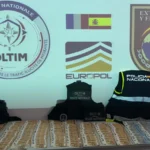
The operation lasted more than two years and led to the arrest of ten individuals and the seizure of nearly EUR 900 000 in cash.
Victims were lured to fake online investment platforms through deceptive advertisements on social media or in web search results, with promises of high returns. They were persuaded to believe in false investment opportunities and to transfer large sums of money.
After registering with these fake brokers, victims were contacted by so-called “retention agents” pretending to be investment advisers or brokers. These agents managed the victims’ accounts over long periods and often used remote access software to gain full control of their electronic devices.
The fraudsters pretended to be professional experts and used psychological pressure to convince victims to invest even more, falsely promising further profits.
Operators were organised into teams of six to eight individuals, each using a specific language to target their respective national markets. Languages covered included German, English, Italian, Greek, and Spanish. Language familiarity was used to create and build trust.
The perpetrators also re-contacted victims who had already lost money through fraudulent platforms, offering services to recover their funds. Interested individuals were instructed to open accounts on cryptocurrency platforms and make an initial deposit of EUR 500. Operators, using usernames and operating under pseudonyms, persuaded victims to make this initial payment trying to scam them again.
The investigation was initially launched by the Austrian authorities due to the large number of victims identified in Vienna around June 2023. In April 2024, the Austrian authorities, through Europol, addressed the Albanian authorities with a request for information regarding an IP address suspected of being used by the perpetrators, who were located in Albania.
With the support of Eurojust, a joint investigation was launched, leading to a coordinated action day on 17 April 2026. The searches conducted at three call centres and nine private homes lead to the seizure of EUR 891 735 in cash, 443 computers, 238 mobile phones, 6 laptops, as well as various data carriers and storage mediums.
Victims of this fraud scheme were located across Europe and worldwide, including in Italy, Germany, Greece, Spain, Canada, and the United Kingdom.
EU’s response to an evolving criminal landscape
In June 2026, the Commission proposed new measures to strengthen the EU’s response to an evolving criminal landscape. New proposals cover the full chain of EU support to Member States, from prevention, detection and investigation to judicial cooperation and effective prosecution. It will strengthen the mandates of Europol and Eurojust, a revision of the European Investigation Order, and amendments to the Data Protection Regulation for Union institutions and bodies.
For more information: European Commission
Publicaciones relacionadas:
 Spain dismantles criminal network smuggling migrants from Algeria to the EU
 12 members of an Irish high-risk criminal network arrested
 Encrypted app reveals criminal networks across Europe
 Two-way migrant smuggling network busted in France and Spain
 28 ‘Ndrangheta associates arrested for drug trafficking and violence
Leave a Reply