• Skip to primary navigation
  • Skip to main content
  • Skip to primary sidebar
  • Skip to footer
  • Bluesky
  • Facebook
  • Instagram
  • Twitter
  • YouTube
CDE Almería – Centro de Documentación Europea – Universidad de Almería

CDE Almería - Centro de Documentación Europea - Universidad de Almería

Centro de Documentación Europea de la Universidad de Almería

  • HOME
  • WHAT´S ON
    • EU NEWS
    • Activities
    • EU Calls and Awards
    • Radio Program «Europe with You»
  • DOCUMENTATION
    • EU Media Collection
      • Web Space
      • MEDIATHEQUE REPOSITORY
  • Europe on the net
    • Institutions
    • EU Representation in Spain
    • European information network of Andalusia
  • ABOUT US
    • Presentation
    • Services
    • People
    • Contact
  • Spanish
  • English

Founding treaty of EU’s predecessor turns 75

Inicio » EU News » Institutional Affairs » Founding treaty of EU’s predecessor turns 75

20 de April de 2026

On April 18 it was celebrated 75 years since the signing of the Treaty of Paris establishing the European Coal and Steel Community (ECSC), the first Treaty that led to the creation of the European Union.
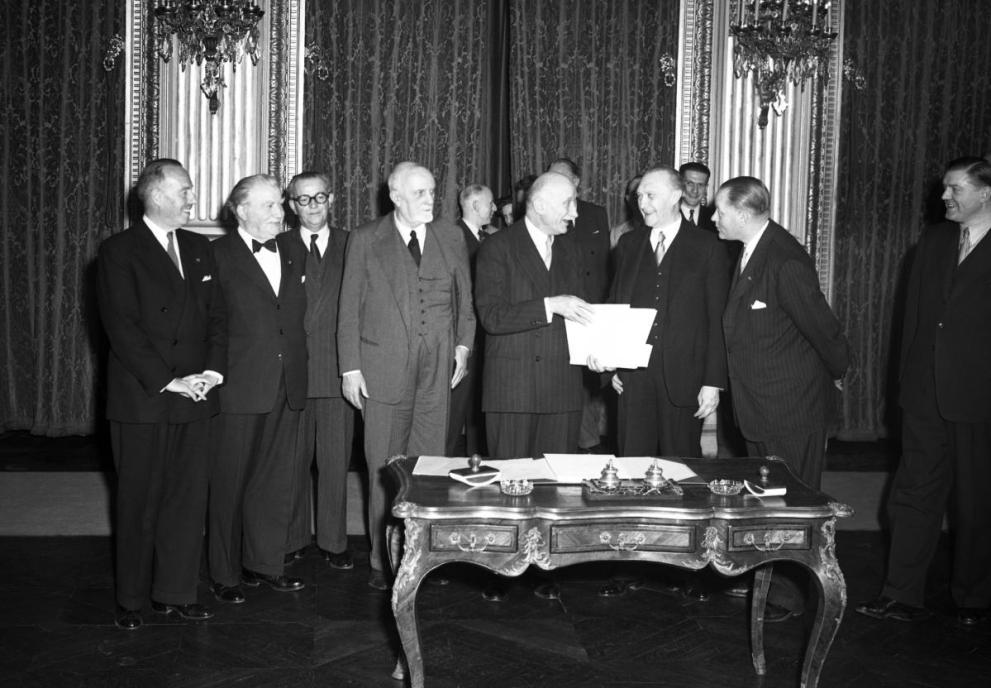
Signed by Belgium, the Federal Republic of Germany, France, Italy, Luxembourg and the Netherlands, it paved the way for deepening European economic integration and the establishment of the European Economic Community with the 1957 Treaty of Rome and the European Union with the 1992 Treaty of Maastricht.

French Minister for Foreign Affairs Robert Schuman put forward the idea of a coal and steel community in his now famous ‘Schuman Declaration’ on 9 May 1950. Following the devastating effects of the second world war, he asserted: “solidarity in production thus established will make it plain that any war between France and Germany becomes not merely unthinkable, but materially impossible”.

A year later the ECSC was launched. The Community’s primary aim was to organise the free movement of coal and steel, free up access to sources of production and ensure price transparency.

At that time, the choice of coal and steel was highly symbolic: in the early 1950s, coal and steel were vital industries. In addition to the economic benefits, the pooling of French and German resources was intended to mark the end of the rivalry between the two countries. The common coal and steel market was to be an experiment which could gradually be extended to other economic spheres, culminating in a political Europe.

This Treaty also laid the foundations of many of the EU’s modern-day institutions by setting up an executive known as the ‘High Authority’, the predecessor of today’s European Commission, a Parliamentary Assembly, a Council of Ministers, a Court of Justice and a Consultative Committee.

For more information: European Commission

Publicaciones relacionadas:
Modernising the cohesion policy to meet current challenges Ursula von der LeyenPresident Ursula von der Leyen in Uzbekistan to take the EU-Central Asia partnership to the next level Commissioner Dubravka Šuica participates in the Forum on the Future of the Mediterranean in Granada The European Union and Central Asia establish a Strategic Partnership during groundbreaking summit Fotografía representativa del bloque del bloque de representación de la comisión en EspañaTrade countermeasures against US


EU News,  Institutional Affairs celebration,  economic integration,  European Coal and Steel Community,  European Commission,  European Union,  News,  Schuman Declaration,  Solidarity,  Treaty of Paris

“This is a space for debate. All comments, for or against publication, that are respectful and do not contain expressions that are discriminatory, defamatory or contrary to current legislation will be published”.

Reader Interactions

Leave a Reply Cancel reply

Your email address will not be published. Required fields are marked *

This site uses Akismet to reduce spam. Learn how your comment data is processed.

Primary Sidebar

Footer

  • CDE Almería
  • Biblioteca Nicolás Salmerón – Universidad de Almería
  • Planta: 1ª, Despacho: 1.05.0B.
  • Ctra. Sacramento s/n. Almería (Spain)
  • Teléfono: (+34) 950 015266

HOME
NEWS
DOCUMENTATION
EUROPE ON THE NET
ABOUT US

  • LEGAL NOTICE
  • PRIVACY POLICY
  • COOKIE POLICY
  • ACCESSIBILITY
  • SITEMAP

Copyright © 2026 CDE Almería · Creative Commons LicenseThis work is licensed under a Creative Commons Attribution-NonCommercial 4.0 International License.

<p>El Centro de Documentación Europea de la Universidad de Almería utiliza cookies propias y de terceros para facilitar al usuario la navegación en su página Web y el acceso a los distintos contenidos alojados en la misma. Asimismo, se utilizan cookies analíticas de terceros para medir la interacción de los usuarios con el sitio Web. Pinche el siguiente enlace si desea información sobre el uso de cookies y como deshabilitarlas. </p>

Politica de privacidad

El Centro de Documentación Europea de la Universidad de Almería utiliza cookies propias y de terceros para facilitar al usuario la navegación en su página Web y el acceso a los distintos contenidos alojados en la misma. Asimismo, se utilizan cookies analíticas de terceros para medir la interacción de los usuarios con el sitio Web. Pinche el siguiente enlace si desea información sobre el uso de cookies y como deshabilitarlas. <a href="/politica-de-cookies" rel="noopener" target="_blank">Más información</a>

Cookies estrictamente necesarias

Las cookies estrictamente necesarias tiene que activarse siempre para que podamos guardar tus preferencias de ajustes de cookies.

Básicamente la web no funcionara bien si no las activas.

Estas cookies son:

  • Comprobación de inicio de sesión.
  • Cookies de seguridad.
  • Aceptación/rechazo previo de cookies.
Cookies de terceros

Esta web utiliza Google Analytics, Google Tag Manager y Yandex Metrika para recopilar información anónima tal como el número de visitantes del sitio, o las páginas más populares.

Dejar estas cookies activas nos permite mejorar nuestra web.

Política de cookies

Pinche el siguiente enlace si desea información sobre el uso de cookies y como deshabilitarlas. Más información