
The EU and Japan held their second Digital Partnership Council in Brussels. The Council was co-chaired by Commissioner for the Internal Market, Thierry Breton, and by Japanese Minister for Digital Transformation, Taro Kono, the Minister of Internal Affairs and Communications, Takeaki Matsumoto, and the Parliamentary Vice-Minister of Economy, Trade and Industry, Taku Ishii.
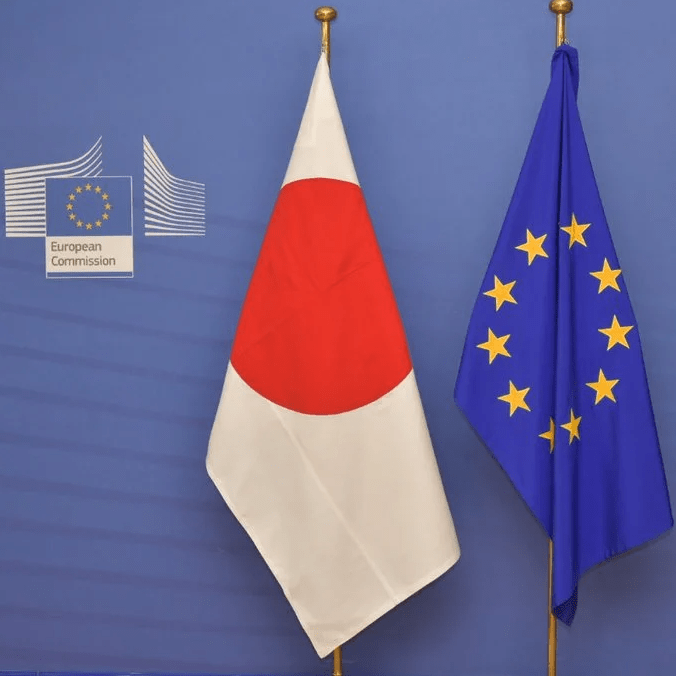
The EU and Japan reaffirmed the importance of their strategic partnership to promote their shared values and vision for a digital transformation that puts people at the centre and respects fundamental rights. The partners welcomed the successful implementation of the Digital Partnership and took stock of the progress achieved since the first Digital Partnership Council in 2023. They agreed on a list of new deliverables to further cooperate on core digital technologies such as artificial intelligence (AI), 5G, 6G, semiconductors, high performance computing (HPC) and quantum technology, strengthening the collaboration in data and platform economy, submarine cables, eID and cybersecurity.
Key outcomes of the second Digital Partnership Council
The EU and Japan signed a Memorandum of Cooperation on digital identities and trust services. This Memorandum will build a shared understanding of digital identity initiatives between the EU and Japan creating benefits for e-commerce and business opportunities by cutting red tape and boosting efficiency. The Memorandum will facilitate data free flow with trust through cooperation and use cases on the basis of the EU Digital Identity Wallet and trust services. It is expected to be presented as a “joint best practice” at the next OECD Ministerial meeting that takes place on 2 and 3 May 2024.
In the area of semiconductors, the EU and Japan decided to set up a team of experts that will develop a research programme to implement the Memorandum of Cooperation on Semiconductors of July 2023. They are also preparing an administrative arrangement to foster exchange of information on public support schemes.
The EU and Japan will continue their joint work on high performance computing (HPC) and have identified hybrid Quantum-HPC applications and use cases to further cooperate. They will consider topics for joint projects in basic research in quantum. The two partners are also exploring cooperation on cybersecurity, including standards and ways to address the skills gap.

The European Union to conclude a Strategic Partnership Agreement with Japan |
On 6G, the EU and Japan have launched collaborative research projects and intend to support global standardisation initiatives, crucial in developing 6G technologies. Both sides reaffirmed their shared vision for open and resilient networks.
In addition, the partners announced their intention to enhance cooperation between the EU AI Office and Japan’s AI Safety Institute. They will continue supporting the G7 Hiroshima AI Process and Code of Conduct to shape a trustworthy AI global governance. The EU also encouraged Japanese companies to participate to the AI Pact launched by the Commission to foster early compliance with key provisions of the AI Act on a voluntary basis before it enters into force and becomes generally applicable.
The EU and Japan confirmed the importance of deploying secure and resilient submarine cable infrastructures, in line with the Memorandum of Cooperation on submarine cables for secure, resilient and sustainable global connectivity signed on 3 July 2023, between the European Commission and the Ministry of Internal Affairs and Communications. Both sides will continue cooperation on developing direct connectivity links between Europe and Japan, for example, via the Arctic, to bring forward commercial opportunities, trusted cross-border data flows and oceanographic research.
Finally, to ensure a safe online environment where freedom of expression is guaranteed, the EU and Japan agreed to explore establishing a regular information sharing channel on online platforms regulations, such as the European Digital Services and Digital Markets Acts.
Next Steps
The next Digital Partnership Council is planned for 2025, in Tokyo, Japan.
Background
The EU and Japan are both among the world’s largest digital economies. They launched the first ever Digital Partnership on 12 May 2022 during the 29th Japan-EU summit in Tokyo. The aim of the Digital Partnership is to advance cooperation on digital issues mainly through enhanced collaborative research on cutting-edge technologies, regulatory dialogue and convergence and shaping common positions in international fora.
The EU-Japan Digital Partnership is part of the EU strategy for Cooperation in the Indo-Pacific that aims to strengthen the EU’s partnerships in Asia.
More information: European Commission
Publicaciones relacionadas:
 European Union strengthens its digital partnership with Colombia through Digital Economy Package
 EU and Japan launch Enhanced Dialogue on advanced materials
 SOTEU 2020: President Von der Leyen sets the course for Europe
 EU-US: A new transatlantic agenda for global change
 Nearly 70 billion euros in Spain’s Recovery Plan
Leave a Reply