
Last November 19, the member states’ representatives (Coreper) approved the Council’s negotiating mandate for an EU law that will allow for the launch of an EU digital travel application. The regulation establishes rules on the (voluntary) creation of digital travel credentials and how to use them when crossing external borders.
The EU digital travel application will make it possible to digitally provide travel data before crossing the border. This clears the path for border officers to remotely verify travel documents and check against border, police and migration databases before travellers arrive in person at a border crossing point. This will shorten waiting times and improve security checks.
The application will be an important element in managing external borders. Travellers will still need to carry their passport or identity card when crossing an external EU border.
Source: European Commission
Backend, movile component and router
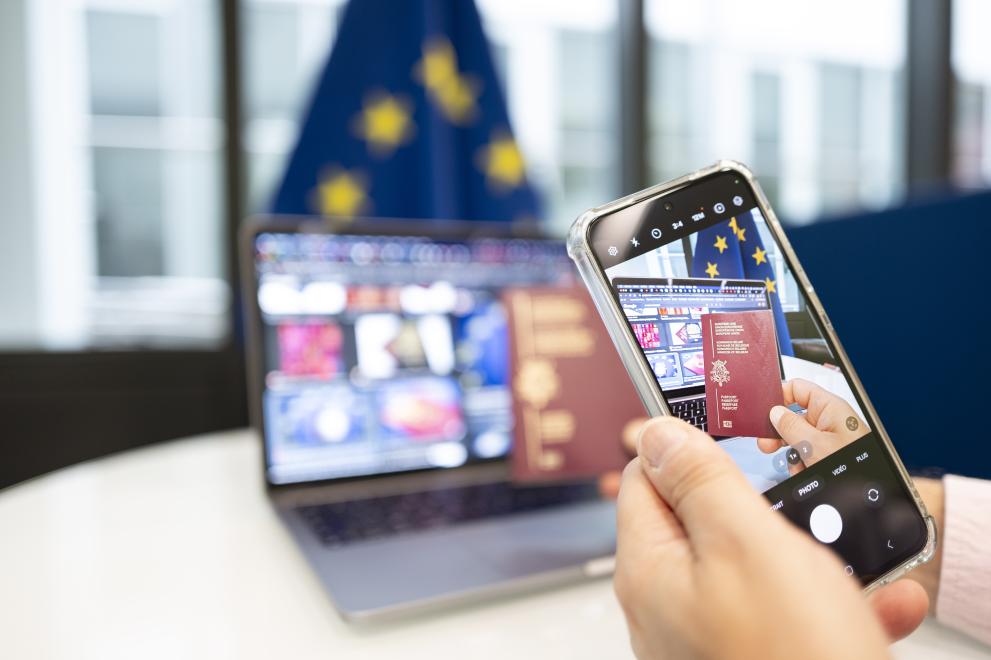
The EU digital travel application will be composed of a mobile component (a mobile app), a backend validation service and a traveller router. All three elements will now be developed by an EU body (eu-LISA) according to the functional and technical requirements included in the regulation.
The mobile component will enable travellers, both EU citizens and third-country nationals, to create digital travel credentials (essentially a digital copy of the data stored on their passport or identity card). However, creating and using digital travel credentials will remain optional.
The backend feature of the digital travel application will serve to electronically verify a travel document’s chip. This is necessary to confirm that the digitally recreated travel document was issued by a legitimate authority and that the data extracted from the chip has not been altered since the travel document was issued.
Thanks to the traveller router, people will be able to share their digital travel credentials with the appropriate authorities in charge of border management.
Use at border crossings
Anyone who has used the EU digital travel application to create digital travel credentials will be able to submit their travel documents to the border authorities in advance of their trip. This will improve the efficiency of border checks as border guards will be able to focus their time and resources on crossings they have flagged as suspicious ahead of time.
Digital travel credentials will also make the Schengen area more secure. It will become easier to verify the authenticity and correctness of travel documents, making it harder for fraudsters to use fake documents or pass through borders undetected.
Connecting the EU’s border and travel IT systems
The EU has put in place a number of IT systems to facilitate travel and reinforce border security. The Council wants the future EU digital travel application to play a central role when people make use of these systems.
According to the Council position, travellers should for instance be able to use their digital travel credentials when pre-submitting their Entry/Exit data. The digital Entry/Exit border system became operational in October 2025 and digitally records entries, exits, and the passport and biometric data of non-EU nationals travelling to the EU.
In 2026, the travel authorisation system ETIAS will be rolled out. Once it is available, non-EU travellers should be able to use the travel credentials created in the digital travel application for their ETIAS application. The same will be the case when digitally applying for a visa.
Next steps
With this agreement, the Council presidency is ready to start negotiations with the European Parliament, once the latter has agreed its position.
Background
According to Commission data, 593 million crossings of the EU’s external borders were recorded in 2022. Such a high number of travellers can be a challenge for those responsible for carrying out border checks. It may also be stressful for people who want to cross the border and have to face long waiting times.
Publicaciones relacionadas:
 Commission acts to enforce timely EU directive transposition
 Commission launches whistleblowing tool under the AI Regulation
45% of the laws passed in Spain in 2025 derive from European directives and decisions.
The Commission updates EU competition rules on technology licensing agreements
Non-transposition of EU legislation: Commission takes action to ensure complete and timely transposition of EU directives
Commission launches whistleblowing tool under the AI Regulation
45% of the laws passed in Spain in 2025 derive from European directives and decisions.
The Commission updates EU competition rules on technology licensing agreements
Non-transposition of EU legislation: Commission takes action to ensure complete and timely transposition of EU directives
Leave a Reply