
The European Union (EU) has faced a series of unprecedented and unexpected challenges since the adoption of the Multiannual Financial Framework (MFF) in 2020. Barely out of one of the deepest global economic crises in more than a century, Russia’s brutal invasion of Ukraine had huge humanitarian, economic and budgetary consequences.
Migration has picked up after the pandemic, putting strains on Member States’ reception and integration capacities. Under the New Pact on Migration and Asylum, the Union and the Member States will be taking on new responsibilities, which imply additional costs.
The steep acceleration in inflation and interest rates has impacted the Union’s budget, amongst others through a sharp increase in NextGenerationEU funding costs.
Following a series of global supply chain disruptions, the EU is working to increase its open strategic autonomy. Significant investment is needed to foster long-term competitiveness in technologies crucial for Europe’s leadership.
Within its current bounds, the EU budget has powered a strong EU response, by drawing from its limited built-in flexibilities and through extensive reprogramming. Addressing these multiple challenges has pushed the resources of the EU budget to the point of exhaustion, hindering the EU budget’s capacity to address even the most urgent challenges.

An EU approach to enhance economic security
|
Today’s proposals seek to provide for targeted reinforcements in a limited number of priority areas, to ensure that the EU budget can continue to deliver on the most essential objectives. The main elements are:
- A Ukraine facility, based on grants, loans and guarantees, with an overall capacity of €50 billion in the period 2024-2027 to cater for Ukraine’s immediate needs, recovery and modernisation on its path towards the EU.
- A reinforcement of the EU budget to address internal and external dimensions of migration as well as needs arising from the global consequences of Russia’s war of aggression in Ukraine, and to strengthen partnerships with key third countries with €15 billion.
- A Strategic Technologies for Europe Platform (STEP) to promote the EU’s long-term competitiveness on critical technologies, in the fields of digital and deep tech, clean tech and biotech. For a quick and effective deployment on the ground, this platform builds on and tops up existing instruments including InvestEU, the Innovation Fund, the European Innovation Council (EIC) and the European Defence Fund, while also introducing new flexibilities and incentives for cohesion funding and the Recovery and Resilience Facility.
- An efficient mechanism to cater for the higher NextGenerationEU funding costs due to the unprecedented surge in interest rates. A new special ‘EURI Instrument’ will cover exclusively the costs that come on top of the original projections that were made in 2020.
- Además, se ajustará la capacidad administrativa de la UE para atender a las nuevas tareas decididas por los colegisladores desde 2020 y cumplir las obligaciones contractuales ajustadas a la inflación.
Areas to be reinforced
1. Long-term support for Ukraine
As part of today’s revision, the Commission is proposing a dedicated Facility to support Ukraine up to 2027. This will come in the form of an integrated and flexible instrument with an overall capacity of €50 billion over 2024-2027. The annual amounts will be defined each year depending on Ukraine’s needs and the evolving situation. This instrument will ensure stable and predictable funding under a framework that contributes to the sustainability of Ukraine’s finances while ensuring the protection of the EU budget.
Underpinned by a Ukraine Plan to be presented by the Government of Ukraine, the Ukraine Facility will support Ukraine’s efforts to sustain macro-financial stability, promote recovery as well as modernise the country whilst implementing key reforms on its EU accession track.
Funding will be provided in the form of loans and non-repayable support (grants and guarantees). The actual split between loans and grants will also be decided annually.
The loan support will be financed by borrowing on financial markets and backed by the headroom of the EU budget. The non-repayable support will be financed through the EU annual budget under a new special instrument, the “Ukraine Reserve” with resources over and above the MFF expenditure ceilings.
2. Managing migration, strengthening partnerships and addressing emergencies
The instability in Europe’s neighbourhood and the humanitarian needs in third countries are deepening. To continue to be able to address internal and external migration challenges and strengthen the EU partnerships with key third countries, the Commission is proposing the following targeted reinforcements to the EU budget.
- To provide sufficient funding for managing migration and border control as well as the implementation of the New Pact on Migration, the Commission proposes to provide €2 billion.
- To allow the Union to respond to heightened economic and geopolitical instabilities, the Commission proposes to increase the ceiling of Heading 6 (Neighbourhood and the world) with additional €10.5 billion.
- To support the Union’s capacity to react to crises and natural disasters the special instrument ´Solidarity and Emergency Aid Reserve´ should be increased with €2.5 billion.
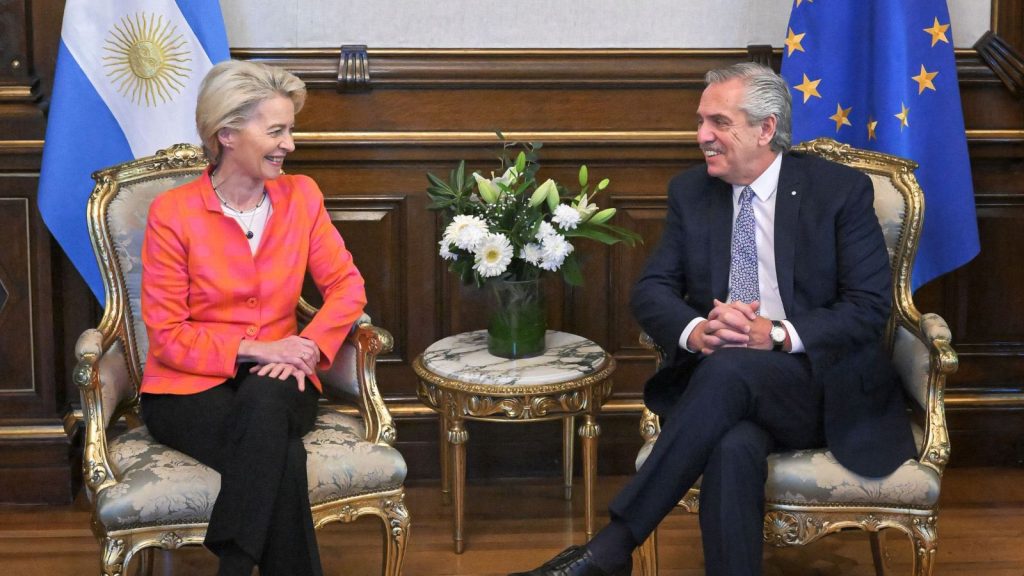
EU and Argentina step up cooperation on raw materials
|
3. Promoting long-term competitiveness via a Strategic Technologies European Platform (STEP)
To support the competitiveness of the EU industry through investments in critical technologies, as announced by President von der Leyen in her State of the Union address of September 2022, the Commission proposes the creation of a new Strategic Technologies for Europe Platform (STEP) with the capacity to generate €160 billion of investments.
STEP will build on existing programmes: InvestEU, Innovation Fund, Horizon Europe, European Defence Fund, Recovery and Resilience Facility, EU4Health, Digital Europe and cohesion funds. In addition, an innovative and dynamic structure will be set up to direct existing funding towards STEP projects and speed up implementation in areas which have been identified as crucial for Europe’s leadership.
Across programmes, the Commission proposes a ‘Sovereignty seal’ enabling better access to funding across EU-funded instruments.
To boost investments in the development and manufacturing of critical digital and deep tech, clean tech and biotech and in their respective value chains, the Commission further proposes to allocate an additional €10 billion to targeted programmes: €3 billion for InvestEU, €0.5 billion to Horizon Europe, €5 billion to the Innovation Fund and €1.5 for the European Defence Fund. These top-ups, together with the cohesion policy and RRF incentives, have the potential to generate around €160 billion investments by European businesses in projects promoting European sovereignty.
Finally, the Commission proposes the creation of a new ‘One-Stop-Shop’ and a dedicated new online Sovereignty Portal to support projects’ promoters and EU countries in their STEP investments supported by the different EU funds.
Next steps
The proposed amendments to the budget, as well as the various legislative proposals presented today, will now be taken forward with the European Parliament and EU Member States in the Council.
To make sure the EU has the necessary resources to continue to address the challenges of today and tomorrow, a timely agreement on the package is essential. The Commission counts on the Spanish Presidency of the Council of the European Union to take work in the Council forward in view of a swift agreement immediately after the summer. The negotiations, including the Parliament’s consent, must be concluded before the end of the year, given that urgent budgetary constraints will already materialise in 2024.
More information: European Commission
Publicaciones relacionadas:
 European Union publishes winter economic forecast for 2023
 The European Commission is providing guidance to Member States on the conduct and coordination of fiscal policy for next year
 Commission proposes new economic governance rules fit for the future
 The European Commission has presented its proposal for the next generation of own resources
 European Semester Autumn Package
Leave a Reply