
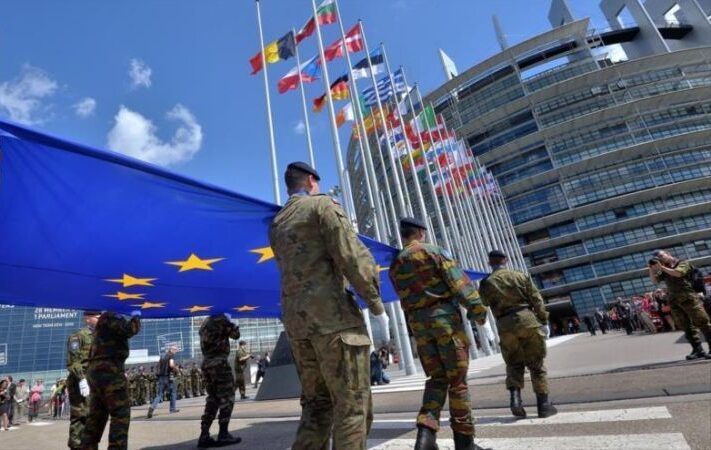
To make it easier for troops, equipment and military assets to move quickly and smoothly across Europe, the European Commission and the High Representative step up defence readiness, focusing on preparedness, with a military mobility package: new Regulation on military mobility and Joint Communication.
The Commission also aims at boosting disruptive innovation in the military area and strengthening Europe’s defence industry with an EU Defence Industry Transformation Roadmap.
Enabling movement at scale and speed
Creating an EU-wide military mobility area by 2027, the military mobility package brings the EU one step closer towards a ‘Military Schengen.’ It will make it faster, safer, and more coordinated to move troops and military equipment across Europe by:
- Removing regulatory barriers: introduces the first-ever EU-level harmonised rules on military mobility and sets clear rules and procedures for cross-border military movements, with a maximum three-day processing time and streamlined customs formalities.
- Creating an emergency framework: a new European Military Mobility Enhanced Response System (EMERS) for fast-track procedures and priority access to infrastructure, supporting armed forces acting in the context of EU or NATO.
- Enhancing the resilience of transport infrastructure: upgrades key EU military mobility corridors to dual-use standards and protecting strategic infrastructure with a new resilience toolbox. Targeted investments will strengthen cybersecurity, energy security and readiness in both peace and crisis.
- Pooling and sharing capabilities: enhances preparedness, solidarity and availability of military mobility capabilities for Member States by introducing a Solidarity Pool and the possibility to create a Military Mobility Digital Information System.
- Strengthening governance and coordination: A new Military Mobility Transport Group and an enhanced Trans-European Transport Network TEN-T Committee will guide implementation and monitor readiness, supported by National Cross-border Military Transport coordinators in each Member States.
Unlocking disruptive innovation for Defence Readiness
The ‘EU Defence Industry Transformation Roadmap: Unleashing Disruptive Innovation for Defence Readiness’ plans to accelerate the modernisation of the European defence industry and support emerging defence players.
It aims to bring together the deep tech and defence communities, speed up the use of advanced technologies in military capabilities and boost Europe’s production capacity through innovation.
To achieve this, it focuses on four priorities: supporting investment in defence companies, accelerating the development of new technologies, expanding access to defence capabilities and fostering the skills needed to sustain Europe’s technological edge.
Russia’s war of aggression against Ukraine has shown how quickly defence technologies evolve. Innovations such as AI, quantum systems, drones and space technologies are reshaping the battlefield. New defence actors, from startups to innovative SMEs, are changing how Europe develops and produces military capabilities.
Europe must learn from Ukraine’s experience, strengthen its resilience and build a new defence ecosystem that unites industry leaders, new innovators and the tech community to deliver capabilities faster and more efficiently.
Next Steps
The Commission will present the new Regulation on military mobility to the Council and the European Parliament for adoption under the ordinary legislative procedure.
The Commission will immediately start implementing the Roadmap’s proposed actions to start the transformation of Europe’s defence industrial ecosystem and scale up.
Background
In March 2025, the Commission and the High Representative put forward the White Paper for European Defence – Readiness 2030, complemented by the Commission’s ReArm Europe Plan/Readiness 2030, an ambitious defence package providing financial levers to EU Member States to drive an investment surge in defence capabilities.
The military mobility package and the EU Defence Industry Transformation Roadmap were both highlighted as key priority areas in the White Paper and in the Defence Readiness Roadmap 2030.
The military mobility package 2025 also builds on lessons learned from the revised Action Plan 2.0 and the 2024 Military Mobility Pledge. It has been developed in close coordination with the European External Action Service (EEAS) and the European Defence Agency (EDA), ensuring coherence with NATO standards and procedures.
More information: European Commission
Publicaciones relacionadas:
 European Defence Fund: €1 billion to boost the EU’s defence capabilities
European Defence Fund: €1.2 billion to boost EU defence capabilities and innovation
European Defence Fund: €1 billion to boost the EU’s defence capabilities
European Defence Fund: €1.2 billion to boost EU defence capabilities and innovation
 EU proposes comprehensive new on Climate-Security nexus
 Commission presents the White Paper for European Defence and the ReArm Europe Plan/Readiness 2030
 €910 million to boost European defence
Leave a Reply