
The visit, led by Peter M. Wagner, Head of the European Commission’s Foreign Policy Instruments (FPI) Service, aimed to discuss the EU’s multifaceted engagement in the Democratic Republic of the Congo, focusing on conflict resolution, the strengthening of security institutions and social cohesion in one of Africa’s most complex crisis environments.
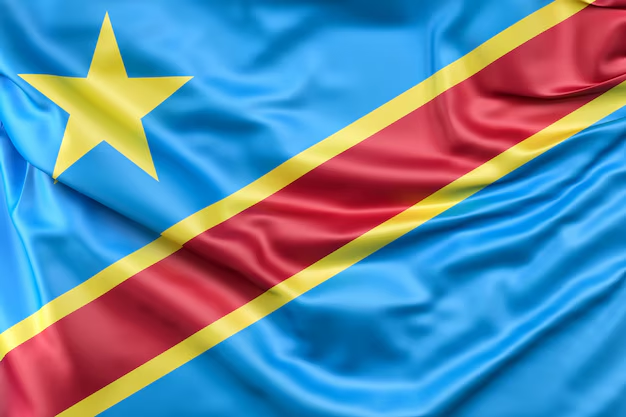
“This visit is proof of our commitment to the DRC and demonstrates the long-standing support of the EU and its Member States. We want to remain a key partner for the DRC and for the region as a whole. Consequently, the work of the Foreign Policy Instruments (FPI) has been very concrete. Whether in the areas of mediation, promoting social cohesion or supporting the armed forces, it demonstrates the EU’s willingness to maintain a firm commitment to peace and stability in the Great Lakes region.” – Peter M. Wagner, Head of the Foreign Policy Instruments (FPI) Service.
EU support in the Democratic Republic of the Congo: the European Peace Facility
The EU’s support for the DRC is comprehensive and covers various aspects of the country’s development. FPI is the administrator of assistance measures under the European Peace Facility (EPF).Through this funding mechanism, the EU has allocated €20 million to provide non-lethal equipment and infrastructure to the Armed Forces of the Democratic Republic of the Congo (FARDC). This support, managed by the Belgian Ministry of Defence, aims to bolster the FARDC’s efforts to defend the country’s territorial integrity and sovereignty.
Military support and crisis response
During his visit, Chief of Staff Wagner handed over individual equipment funded by the EPF, including ballistic helmets, gloves and protective boots, to the 31st Rapid Reaction Brigade at the Kindu military base. Through EU funding for crisis response, amounting to €24 million, FPI also supports mediation, dialogue and reconciliation at community level in the Democratic Republic of the Congo, particularly in the conflict-affected eastern provinces.
Community-level reconciliation: a key approach
A significant portion of FPI funding in the DRC is channelled through civil society organisations. Head of Service Wagner met with FPI-funded NGO consortia (NRCandInterpeace) to discuss their work on dialogue and social cohesion at the community level. Despite operating in difficult conditions, these partners are achieving tangible results. The importance of linking local initiatives with higher-level peace processes was highlighted, emphasising the need for a comprehensive approach to conflict resolution.
High-level discussions and partnerships
In Kinshasa, Head of Service Wagner met with key stakeholders, including ambassadors from EU Member States, government officials and NGOs, to discuss the EU’s support for the DRC peace process. He also held fruitful discussions with the High Representative of the President of the DRC for Peace Processes, Sumbu Sita Mambu, and with the Minister for Foreign Affairs, Thérèse Wagner, focusing on the latest developments in the conflict and the ongoing peace processes.
How to tackle hate speech and disinformation
Head of Service Wagner visitedStudio Hirondelle, a local media outlet supported by the EU to combat hate speech and disinformation in the Democratic Republic of the Congo. The studio produces fact-checking content, including radio programmes and articles, to promote a more informed public debate. During his visit,Wagner was interviewedon local radio about the EU’s work in conflict zones.
The EU’s commitment to peace and stability.
The mission demonstrated the EU’s comprehensive approach to supporting the DRC, combining military support, political dialogue and grassroots peacebuilding. As Wagner highlighted, the visit underscores the EU’s long-standing commitment to the DRC and its dedication to promoting peace and stability in the Great Lakes region. With its comprehensive support, the EU remains a strategic partner in the DRC’s stabilisation efforts.
More information: European Commission.
Publicaciones relacionadas:
 New strategy to strengthen prosperity and security with India
 The EU and Nigeria open negotiations on a bilateral agreement on cooperation in science and technology
 The EU and Montenegro have provisionally closed the chapter on trans-European networks in the accession negotiations
 The EU is stepping up its support for Lebanon as the crisis worsens.
 The Commission proposes a free and secure data circulation zone between the EU and Brazil
Leave a Reply