
Two repatriation flights chartered directly by the European Commission have landed safely in Romania. Both flights brought back to Romania 356 European citizens who were stranded in the Middle East, from Oman. For the first time, the Commission mobilised its own transport and logistics capabilitiesfrom rescEUat the request of the Romanian authorities. This operation marks an important milestone in the expansion of the response toolsof the EU Civil Protection Mechanism(CPM).
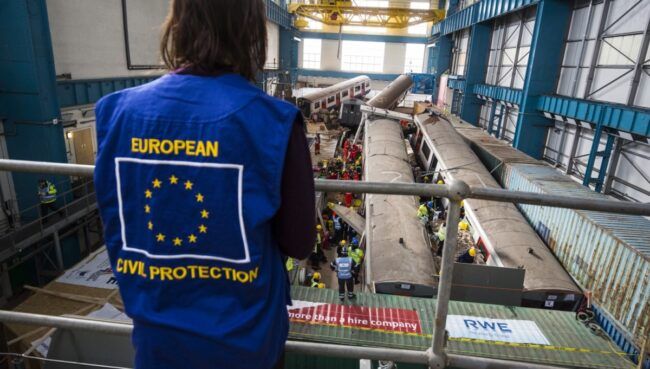
The rescEU capacities were deployed by theEUEmergency Response Coordination Centre(ERCC). When no EU Member State or EPCM participating state can offer transport capacity following a request for assistance, rescEU can be mobilised. It provides an additional level of EU support when national capacities are not available.
In addition to these rescEU flights, the EU has so far supported 42 flights, which have brought more than 4,100 European citizens back safely to Belgium, Bulgaria, the Czech Republic, Italy, Cyprus, Latvia, Lithuania, Luxembourg, the Netherlands, Austria, Portugal, Romania, Slovakia and Sweden.
More flights are planned in the coming days, as a total of 23 countries have requested EU assistance: Belgium, Bulgaria, the Czech Republic, Estonia, Ireland, France, Italy, Cyprus, Latvia, Lithuania, Luxembourg, Malta, the Netherlands, Austria, Poland, Portugal, Romania, Slovenia, Slovakia, Finland, Sweden, Bosnia and Herzegovina, and Montenegro.
The Commission, in coordination with the European External Action Service and EU delegations on the ground, is fully mobilised to support repatriations and is in contact on this issue with EU delegations and Member States’ consular authorities in the region.
Background
Passenger aircraft have been a new rescEU capability since September 2025, and this is the first activation for consular support since then.
The EU plays a key role in coordinating the transport and operational costs of repatriation flights. Following a request for assistance, the EU ERCC promptly mobilises assistance and experts. Under rescEU, the Commission can cover up to 100% of transport costs. This differs from other EU support for repatriations, where cost coverage can reach up to 75% if at least 30% of passengers are citizens of other EU Member States or participating States other than the one that activated the Mechanism.
As consular repatriations are a national competence, Member States or participating States for which rescEU capacities are mobilised are responsible for coordinating all consular aspects of the operations, including the allocation of seats to citizens of other countries concerned under the UCPM and the deployment of consular staff, as necessary. EU delegations on the ground have assisted Member States in ensuring that all EU citizens in need of consular assistance can make full use of these repatriations.
More information: European Commission.
Publicaciones relacionadas:
 Migration: Civil Liberties Committee adopts reform of EU return rules
 The Commission presents the first Strategy on Intergenerational Equity
 New Eurobarometer shows Europeans’ positive attitude towards language learning
 Commission launches first Annual Migration Management Cycle under the Pact on Migration and Asylum
 Commission proposes a Resettlement and Humanitarian Admission Plan for 2026-2027
Leave a Reply