
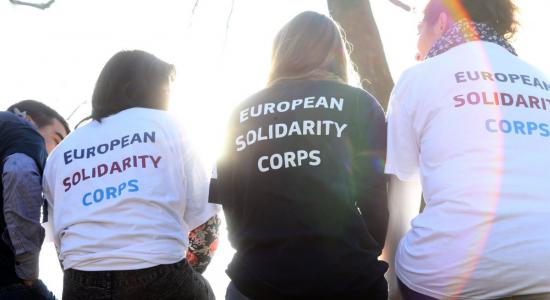
Last Novmeber 14, the European Commission launched the European Solidarity Corps 2026 call, marking a double anniversary year: 30 years of EU volunteering, which started in 1996 with a pilot of the European Voluntary Service, and 10 years of the European Solidarity Corps. With an increased budget of €175.3 million, the programme will continue to empower thousands of young people to engage in solidarity actions across Europe and beyond.
Since its creation in 2016, the European Solidarity Corps has offered life-changing opportunities to more than 150,000 young people and reinforced community building through over 22,000 projects in solidarity, humanitarian aid and development cooperation. The 2026 programme builds on these achievements and will continue to fund projects contributing to its four priorities for 2021-2027: inclusion and diversity, environmental sustainability, digital transformation, and democratic participation.
A strong focus on solidarity in the new Commission mandate
In 2026, the European Solidarity Corps will continue to support volunteering activities, solidarity projects, and networking actions. It will also support quality and support measures, including training and evaluation cycles, IT tools, and Quality Label mechanisms for participating organisations.
The centralised action ‘Volunteering Teams in High-Priority Areas’ will address three annual policy priorities:
- Enhancing preparedness and relief for people affected by armed conflicts or natural disasters, contributing to the new Preparedness Union Strategy.
- Fostering positive learning experiences and improving basic skills for young people with fewer opportunities, in line with the Union of Skills agenda.
- Promoting intergenerational fairness and solidarity, ensuring dialogue and cooperation between generations and combating age discrimination.
These priorities reflect several objectives put forward in the Commission’s 2024–2029 political guidelines and reaffirm the Corps’ role as a catalyst for inclusion, resilience, and empathy in an ever-changing Europe.
A growing demand for solidarity
Following a 100% budget absorption rate since the programme’s start, demand for volunteering opportunities continues to exceed the available funding, with only one in ten registered young people currently able to participate. The increased budget (up 5.6% from 2025) aims to expand access and ensure fair opportunities across all the regions of Member States and associated countries.
The 2026 Work Programme also maintains its global outreach through humanitarian aid volunteering, with a 17.7% increase in funds compared to 2025.
How to apply
Public and private organisations can apply for funding under the 2026 call, expected to be launched following this publication. They must hold a Quality Label to ensure compliance with programme principles and standards. Applications can be submitted through National Agencies in EU Member States and associated countries (Iceland, Liechtenstein, North Macedonia and Türkiye) or via the European Education and Culture Executive Agency (EACEA) for actions under direct management.
Background
Launched in 2016, the European Solidarity Corps builds on a long EU tradition of supporting youth volunteering and community engagement. It connects young people aged 18 to 30 (and up to 35 for humanitarian aid volunteering) with organisations and projects across Europe and beyond.
With an indicative budget of €1.009 billion for 2021–2027, the Corps aims to support more than 185,000 young people in solidarity activities. In 2026, it will also celebrate 30 years since the first EU-funded volunteering initiatives, which paved the way for the European Voluntary Service and later the European Solidarity Corps.
More information: European Commission
Publicaciones relacionadas:
 Commission announces over €5 billion in funding for skills under Erasmus+ 2026
 Erasmus: MEPs are calling for the 2028–2034 programme to be made more accessible
 The Europe Pavilion at the Book Fair celebrates Spain’s 40 years in the EU
 EU to boost financial literacy and investment opportunities for citizens
 Spanish film Sorda, among the finalists for the LUX 2026 Audience Award
Leave a Reply