• Skip to primary navigation
  • Skip to main content
  • Skip to primary sidebar
  • Skip to footer
  • Bluesky
  • Facebook
  • Instagram
  • Twitter
  • YouTube
CDE Almería – Centro de Documentación Europea – Universidad de Almería

CDE Almería - Centro de Documentación Europea - Universidad de Almería

Centro de Documentación Europea de la Universidad de Almería

  • HOME
  • WHAT´S ON
    • EU NEWS
    • Activities
    • EU Calls and Awards
    • Radio Program «Europe with You»
  • DOCUMENTATION
    • EU Media Collection
      • Web Space
      • MEDIATHEQUE REPOSITORY
  • Europe on the net
    • Institutions
    • EU Representation in Spain
    • European information network of Andalusia
  • ABOUT US
    • Presentation
    • Services
    • People
    • Contact
  • Spanish
  • English

EU mobilises assistance for Gaza via Cyprus Maritime Corridor

Inicio » Noticias UE » Asuntos Institucionales » International Politics and Cooperation » EU mobilises assistance for Gaza via Cyprus Maritime Corridor

21 de May de 2024

A new aid shipment from Cyprus to Gaza via the Maritime Corridor and the newly constructed US pier is taking place, carrying EU supplies. Through the EU Civil Protection Mechanism, Romania is sending more than 88,000 cans of food to Palestinians in need. The Commission covers the transport costs of this delivery. An EU logistics hub in Cyprus has also been set up to help handle the further flow of assistance to Gaza.
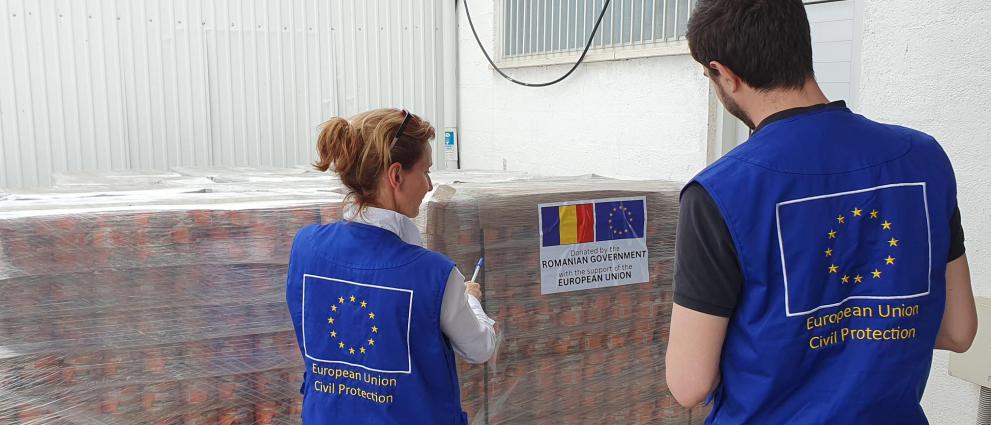
The EU’s Emergency Response Coordination Centre remains in close contact with Member States and humanitarian partners to mobilise offers of assistance via the Maritime Corridor with a view to increasing aid supplies.

This new maritime aid delivery comes on top of the over 2,000 metric tonnes channelled already by EU Humanitarian Air Bridge flights and the €193 million in EU humanitarian funding allocated for Palestinians in need this year.

The maritime corridor is complementary to, and not intended to replace, existing land routes to Gaza, such as through the Kerem Shalom and Rafah crossings. The EU calls on Israel to grant sustained access using new routes such as through the Erez crossing and through use of the port of Ashdod.

Background

This first EU shipment using the US-constructed pier follows the joint announcement made on 8 March 2024, by the European Commission, Germany, Greece, Italy, the Netherlands, the Republic of Cyprus, the United Arab Emirates, the United Kingdom, and the United States, expressing their intent to open a maritime corridor to deliver humanitarian aid to Gaza by sea.

On 28 March 2024, UN Senior Humanitarian and Reconstruction Coordinator for Gaza Sigrid Kaag requested assistance for Gaza under the Union Civil Protection Mechanism including through the Cyprus Maritime Corridor.

European Union increases humanitarian aid to Palestinians

More information: European Commission

Publicaciones relacionadas:

European Union increases humanitarian aid to Palestinians Nagorno-KarabakhEU allocates €130 million in humanitarian aid for Latin America and the Caribbean in 2024 EU steps up humanitarian aid in Colombia by €24 million centroamérica mexicoEuropean Commission announces €11 million in humanitarian aid to Central America and Mexico bandera venezuelaThe European Commission will provide more than 75 M € in humanitarian aid to support Venezuelans



EU News,  Institutional Affairs,  International Politics and Cooperation Cyprus,  EU,  EU Civil Protection Mechanism,  European Commission,  gaza,  Humanitarian Aid,  Romania

“This is a space for debate. All comments, for or against publication, that are respectful and do not contain expressions that are discriminatory, defamatory or contrary to current legislation will be published”.

Reader Interactions

Leave a Reply Cancel reply

Your email address will not be published. Required fields are marked *

This site uses Akismet to reduce spam. Learn how your comment data is processed.

Primary Sidebar

Footer

  • CDE Almería
  • Biblioteca Nicolás Salmerón – Universidad de Almería
  • Planta: 1ª, Despacho: 1.05.0B.
  • Ctra. Sacramento s/n. Almería (Spain)
  • Teléfono: (+34) 950 015266

HOME
NEWS
DOCUMENTATION
EUROPE ON THE NET
ABOUT US

  • LEGAL NOTICE
  • PRIVACY POLICY
  • COOKIE POLICY
  • ACCESSIBILITY
  • SITEMAP

Copyright © 2026 CDE Almería · Creative Commons LicenseThis work is licensed under a Creative Commons Attribution-NonCommercial 4.0 International License.

<p>El Centro de Documentación Europea de la Universidad de Almería utiliza cookies propias y de terceros para facilitar al usuario la navegación en su página Web y el acceso a los distintos contenidos alojados en la misma. Asimismo, se utilizan cookies analíticas de terceros para medir la interacción de los usuarios con el sitio Web. Pinche el siguiente enlace si desea información sobre el uso de cookies y como deshabilitarlas. </p>

Politica de privacidad

El Centro de Documentación Europea de la Universidad de Almería utiliza cookies propias y de terceros para facilitar al usuario la navegación en su página Web y el acceso a los distintos contenidos alojados en la misma. Asimismo, se utilizan cookies analíticas de terceros para medir la interacción de los usuarios con el sitio Web. Pinche el siguiente enlace si desea información sobre el uso de cookies y como deshabilitarlas. <a href="/politica-de-cookies" rel="noopener" target="_blank">Más información</a>

Cookies estrictamente necesarias

Las cookies estrictamente necesarias tiene que activarse siempre para que podamos guardar tus preferencias de ajustes de cookies.

Básicamente la web no funcionara bien si no las activas.

Estas cookies son:

  • Comprobación de inicio de sesión.
  • Cookies de seguridad.
  • Aceptación/rechazo previo de cookies.
Cookies de terceros

Esta web utiliza Google Analytics, Google Tag Manager y Yandex Metrika para recopilar información anónima tal como el número de visitantes del sitio, o las páginas más populares.

Dejar estas cookies activas nos permite mejorar nuestra web.

Política de cookies

Pinche el siguiente enlace si desea información sobre el uso de cookies y como deshabilitarlas. Más información