
The Brussels IX Conference on “Standing with Syria: meeting the needs for a successful transition”, hosted and chaired by the European Union (EU) on 17 March 2025, gathered key regional and international partners together with the Syrian Arab Republic.
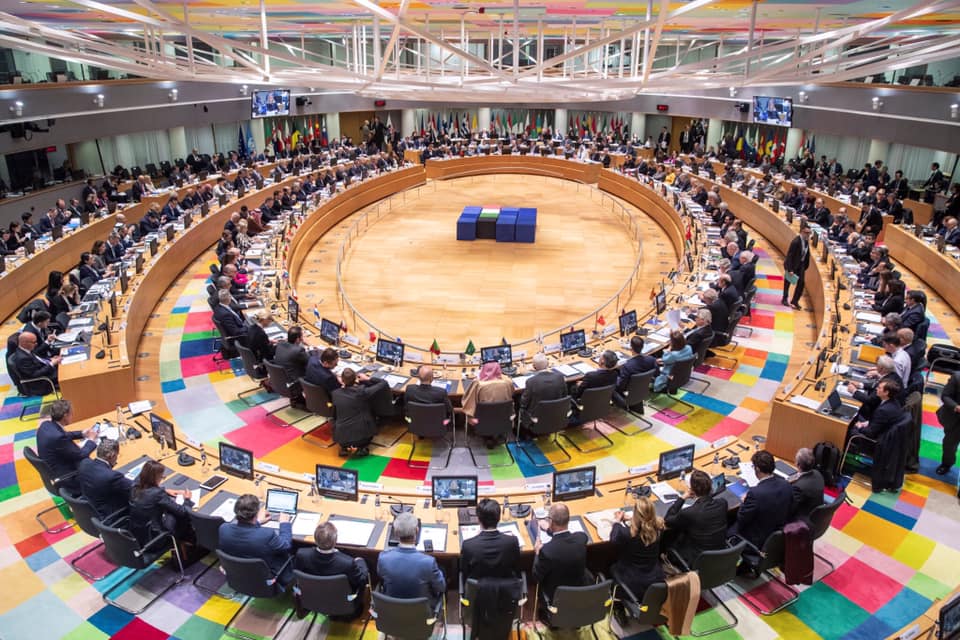
Building on the ministerial meetings in Aqaba (14 December 2024), Riyadh (12 January 2025) and Paris (13 February 2025), the Co-Chairs and Syria’s Minister for Foreign Affairs reaffirmed their wish to work together to ensure the success of the post-Assad transition. The Co-chairs recalled the EU’s commitment to the enduring principles that have guided, since the first Brussels Conference in 2017, the EU’s efforts to support the Syrian people and their host communities in neighbouring countries, including ensuring respect for fundamental freedoms as well as international humanitarian law.
The Co-chairs reaffirmed the EU’s support for the unity, independence, sovereignty and territorial integrity of Syria and highlighted the key role of inclusive state institutions and the fight against all forms of discrimination and extremism. Recognising the historic opportunity to rebuild Syria as a free, inclusive, united, sovereign, stable and peaceful country, grounded on the respect of human rights and international law, the Co-chairs reaffirmed the EU’s commitment to support Syria’s inclusive transition with a view to ensuring lasting peace and prosperity for all Syrians, without distinction of any kind. Both parties concurred on the necessity, including via the National Dialogue process, to ensure that the transition delivers on the aspirations of all components of Syrian society, and for all Syrians, both in the country and in the diaspora, to have the opportunity to reunify, stabilise and rebuild their country, restore justice and freedom and ensure accountabilityn a spirit of reconciliation.
Both parties agreed on the necessity of implementing and supporting the agreement reached on 10 March 2025 with the Syrian Democratic Forces. They reaffirmed the critical importance of preventing the resurgence of terrorism, including Daesh, and touched upon the urgent need to address the issue of non-Syrian nationals held in camps in North-East Syria.
Both parties agreed that rebuilding Syria is a collective and holistic effort, which needs to be inclusive, Syrian-led and Syrian owned, in which the United Nations have an important role to play alongside other stakeholders. They stressed the urgent need to alleviate the suffering of two million Syrians living in camps, as well as those whose livelihoods are affected by external threats on Syrian borders. Both the Co-Chairs and the Syrian Foreign Minister reiterated their call for the full respect of Syria’s unity, sovereignty and territorial integrity. Recalling the historic opportunity to guard against persistent security threats, they agreed on the importance of achieving the full destruction of chemical weapons in Syria, and recalled the important role of OPCW in this regard.
Both parties further underlined the need to work collectively towards discovering the fate of the 150,000 forcibly disappeared Syrians, particularly in Assad’s prisons, whose fates remain unknown, and the EU reaffirmed its support to national and international efforts in this respect.
Recognising the urgent need to restore trust and security within Syrian society, the Co-Chairs and the Syrian Foreign Minister condemned the violent attacks by Assad regime remnants against security forces, and rejected any exploitation of Syria’s situation by any state and non-state actors, including manipulation of information. They reiterated their strongest condemnation of the subsequent retaliation, which resulted in horrific crimes against civilians by a number of armed groups and stressed the utmost necessity of holding all perpetrators accountable. They concurred that swift justice is essential to prevent such crimes from ever recurring again and to ensure that all Syrians, without distinction of any kind, can live without fear in the new Syria. The Co-Chairs welcomed the commitments made by the transitional government, and in particular the establishment of an investigative committee, and called for the UN International Independent Commission of Inquiry to also investigate these acts.
The Co-chairs and Syria’s Minister for Foreign Affairs emphasised the urgency of meeting the needs of the Syrian people and welcomed the pledging efforts deployed by donors for the benefit of Syria and the region announced today, during the Brussels IX Conference. Following the exchanges conducted in Paris on 13 February 2025, they welcomed the intention to establish a new coordination framework to complement and accelerate an inclusive socio-economic recovery and reconstruction. The Co-chairs also re-affirmed their sustained support to accelerated economic recovery and resilience in Syria, to help foster Syria’s state and local institutionsas much as its thriving, diverse and invaluable civil society, building on the already existing longstanding EU support and re-confirmed in this Conference. The EU’s approach in this respect will be commensurate with developments in the country. They also acknowledged the importance of continued support to refugee-hosting countries as long as conditions for voluntary, safe, sustainable and dignified returns are not fully met.
The Co-Chairs conveyed the EU’s intention to support the holding of an event with civil society in Syria, later in 2025, in line with the EU’s longstanding support to Syria’s civil society.
More information: European Council
Publicaciones relacionadas:
 EU pledges €2.5 billion to support Syria and the region
 EU provides €235 million humanitarian aid to Syrians
EU Commission Welcomes Decision to Lift Sanctions on Syria
EU provides €235 million humanitarian aid to Syrians
EU Commission Welcomes Decision to Lift Sanctions on Syria
 Commission presents a financial support package for Ukraine for 2026–2027
 Third payment of close €3.5 billion to Ukraine has been approved by the Council
Leave a Reply