
Speaking at the Munich Security Conference 2025, European Council President António Costa highlighted that the EU will continue to support Ukraine as an integral part of its project for peace.
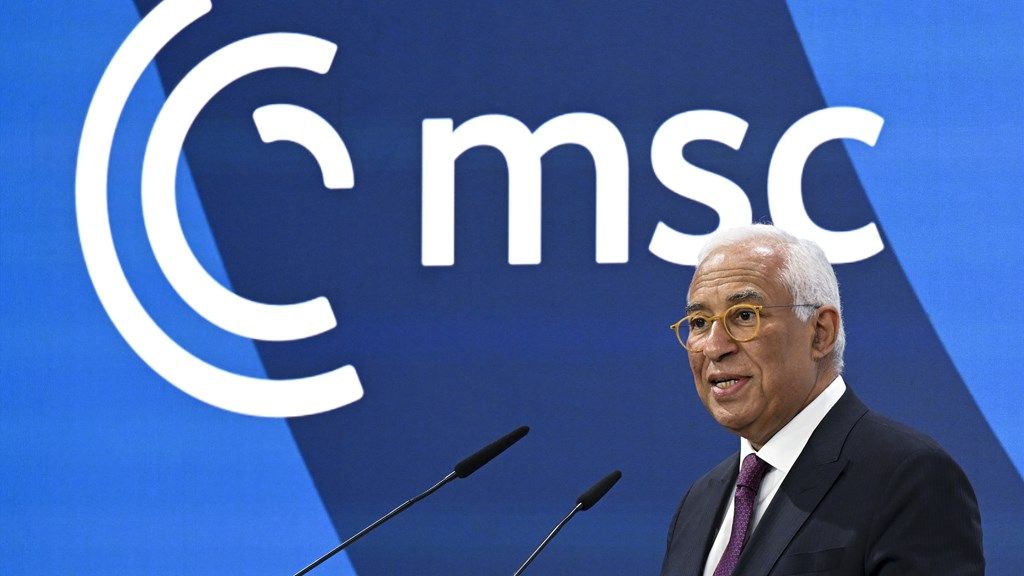
“On 24 February 2022, the European Union changed.
On the very first day of the war in Ukraine, at 7 pm, European leaders gathered for an emergency meeting in Brussels and exchanged with President Zelenskyy. It was a very dramatic discussion. Russia’s tanks were on their way to Kyiv. Russia’s bombs were falling across Ukraine.
Before we ended our meeting, President Zelenskyy said that those were most probably his last moments alive. And I remember very well the clear sense in the room: this was the moment when a new geopolitical European Union was born. Russia’s war of aggression against Ukraine shook Europe’s security architecture to the core.
Together with our transatlantic allies, we acted immediately to support Ukraine’s sovereignty, self-determination and territorial integrity: with humanitarian aid, with economic assistance, with the toughest ever sanctions against Russia and with unprecedented military support. And, perhaps most importantly, with a clear sense of the future for Ukraine as a full member of the European Union.
Three years later Ukraine resists heroically, Putin failed in his attempt to dominate Ukraine and, as we all saw, President Zelenskyy is stronger than ever.
Today my message is clear. We are not giving up. We will continue to support Ukraine as an integral part of our project for peace.
Only Ukraine can define when there are conditions for negotiations. Assuming concessions before any negotiations is a huge mistake. Therefore, we will continue to stand shoulder to shoulder with Ukraine: in the negotiations, providing security guarantees, in reconstruction and as future member of the European Union. This is the EU’s position and, as you heard, is also Ukraine’s position.
What does a comprehensive, just and lasting peace mean? It means that peace in Ukraine and Europe’s security cannot be separated. It means that we take into account that the Russian threat goes beyond Ukraine. Russia dominates Belarus. Russia has a military presence in Moldova and Georgia. Russia casts a shadow over the Baltic States, the European Union’s eastern border, our democratic systems our critical infrastructures. It means that a comprehensive peace cannot be a simple ceasefire. It cannot give Russia the opportunity to attack ever again. It cannot reward the aggressor. It must guarantee that Russia will no longer be a threat to Ukraine, to Europe, to its neighbours that Russia ceases to be a threat to international security.
In building this peace, the European Union will fully assume its responsibilities. In a nutshell, there will be no credible and successful negotiations no lasting peace without Ukraine and without the European Union.
The European Union after February 2022 is not the same as before. First, we sped up enlargement to the Western Balkans and opened negotiations with Ukraine and Moldova. Second, we decided to strengthen our energy security by decoupling from Russia, in a huge collective effort, in particular here in Germany under Olaf Scholz’s leadership. Third, less than a month after the beginning of the war, in Versailles, all Member States decided to effectively deliver on building the Europe of defence.
Our defence spending has risen by 30% since 2021. European Union countries that are in NATO now spend, on average, 2% on defence. Together we have reached the target. But we will do more. The European Union is a peace project by design. But we know that peace without defence is an illusion.
Two weeks ago, I brought together European Union leaders to provide political guidance to the European Commission and the High Representative on the capabilities we jointly need to build, on the mobilisation of more public and private funding and on strengthening our partnerships, namely with the United Kingdom and NATO. The Commission and the High Representative will present proposals next month, and I will keep defence at the top of the European Council’s agenda. This is the direction. This is our commitment.
The European Union is a reliable and predictable partner. A strong economic and powerful trade actor. And we are firmly committed to act better, stronger and faster in building the Europe of defence. Thank you.”
Further information: European Council
Publicaciones relacionadas:
 Council adds the violation of restrictive measures to the list of EU crimes
 President Zelenskyy says Russia is a grave threat to the European way of life
 Statement by the members of the European Council after one year of Russia’s war of aggression against Ukraine
EU condemns illegitimate “elections” in occupied territories of Ukraine
Statement by the members of the European Council after one year of Russia’s war of aggression against Ukraine
EU condemns illegitimate “elections” in occupied territories of Ukraine
 New EU law to modernise judicial cooperation in terrorism cases
Leave a Reply